The Peruvian Government has submitted to Congress a bill «as a matter of urgency» that proposes to appoint the President of the Andean Parliament as the person in charge of the Presidency when the Head of State is out of the country.
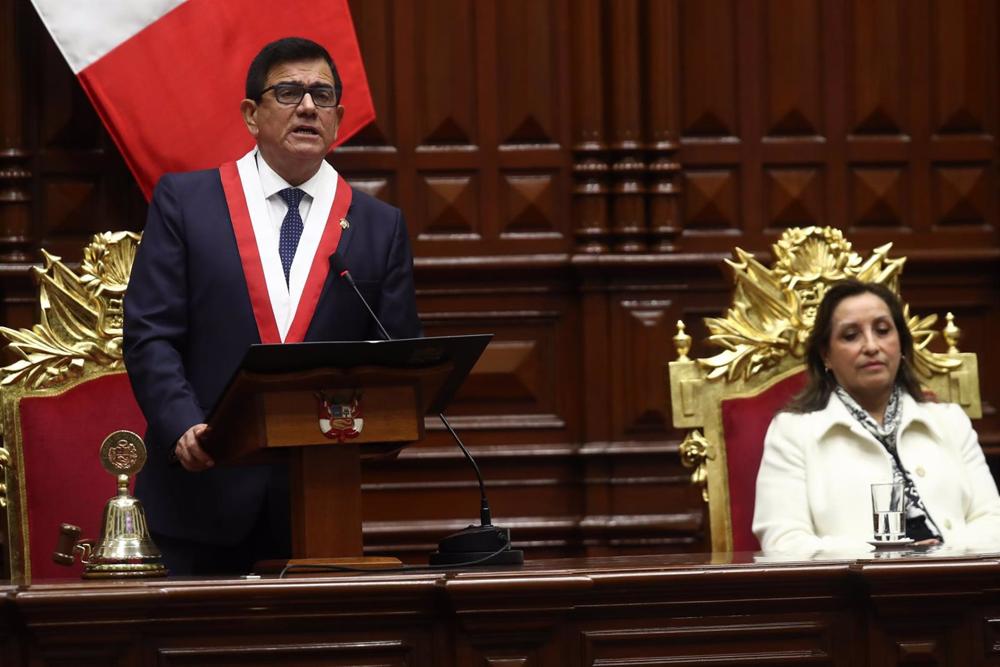
The proposal, submitted to the Congressional Constitution and Regulations Committee, would allow the current head of the lower house, José Williams, to replace President Dina Boluarte when she has to leave the country for activities abroad, as reported by RPP radio station.
In this way, the President of Congress will be able to carry out the representative and administrative functions that allow the normal development of the Presidency, although he will not be able to carry out government acts.
«It is valid in constitutional terms to conclude that it should be the president of Congress who assumes the presidential office in case the president of the Republic travels abroad and his or her vice presidents are prevented from assuming such duties,» reads the bill.
«Now, understanding that it is a ‘sui generis’ scenario that the head of a State power (in this case, the legislative power) assumes the charge of the presidential office (…) does not imply, under any circumstances, that the president of the Republic of Peru in charge may carry out actions different from those of an administrative or representative nature,» it continues.
Regarding the possibility of the President of Peru being replaced by the person holding the office of Head of Government, the bill rules it out by stating that «the person in charge of the presidential office must also be elected by popular vote».
This proposal comes after the confrontations between the Congress and the former Executive, presided by former President Pedro Castillo.
Up to three times the Andean Parliament denied permission to Castillo to attend engagements abroad, alleging that he was being investigated by the Attorney General’s Office and that he was a flight risk.
Specifically, the Congress did not allow the former president to attend the investiture of Gustavo Petro in Colombia, nor to meet in Brussels with the president of the European Commission, Ursula von der Leyen; or with Pope Francis, in the Vatican. Nor was he allowed to go to Mexico to meet with his then counterpart Andrés Manuel López Obrador.
According to Article 102 of the Peruvian Constitution, the Congress has among its powers «to authorize the President of the Republic to leave the country», which is why Castillo had to request permission every time he wanted to travel out of the country.
Source: (EUROPA PRESS)