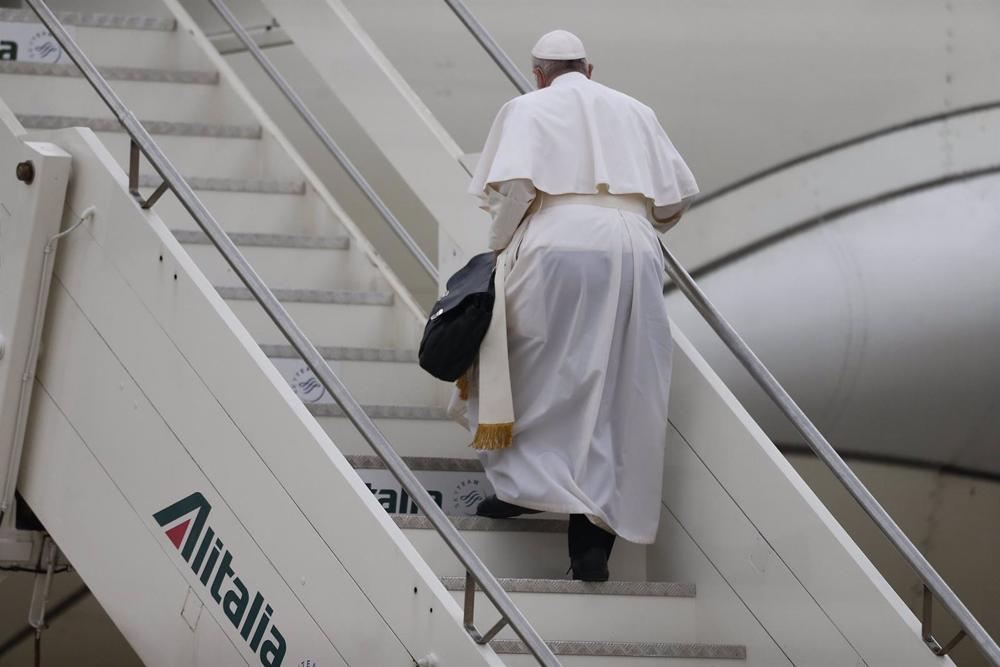
The Pope travels this week – from January 31 to February 5 – to the Democratic Republic of Congo (DR) and South Sudan to bring «a word of peace» to two countries ravaged by war, terrorist attacks and climate change. In this way, he is resuming the visit he had to postpone last July due to problems with his knee.
Francis travels for the fourth time in his almost ten years of Pontificate to Africa and with DRC and South Sudan will be ten countries of the continent that he will have visited. In 2015 he visited Kenya, Uganda and Central African Republic; Morocco, in March 2019; and later, Mozambique, Madagascar and Mauritius in the same year.
The Pope travels to the area shortly after last January 15 at least 17 people were killed and twenty injured in a bomb attack on an evangelical church in Kasindi, a border town between DR Congo and Uganda, an area to which the Pontiff will not travel in any case.
«THERE ARE NO CONCRETE THREATS»
However, the Vatican considers that «there is no concrete threat», as moved by the director of the Press Office, Matteo Bruni, who also assured that the local authorities have put in place «all security measures to ensure the safety of all». «It is a beautiful journey to bring a word of peace,» he said, stressing that about 20% of the world’s Catholics live on the African continent, and that percentage is increasing.
Even so, wars are being fought in the two countries Francis will visit. «If the one in South Sudan resembles an ancient ethnic war, the one in eastern DR Congo is post-modern, it is a war that continues almost for internal reasons because there has been a privatization of the arms trade, there are many people living from this situation and when there are many opposing groups it is difficult to find the political crux of the matter,» explained Italian politician Mario Giro, a member of the Community of Sant’Egidio.
The Pontiff will arrive this Tuesday in the capital of DR Congo, Kinshasa, with a message of reconciliation and hope. There he will meet the President of the Republic, Felix Tshisekedi, and will deliver his first speech to the authorities, civil society and the diplomatic corps.
He will not visit Goma Francis wanted to travel to Goma to touch the misery of the people. In fact, it was planned in the agenda of the July 2022 trip, but finally that stage has had to be canceled for security reasons. «I’m not going because I’m afraid. Nothing will happen to me, but with an atmosphere like this and seeing what they are doing, they throw a bomb in the stadium and kill many people,» said the Pope last December in an interview with ‘Mundo Negro’.
On Wednesday, Pope Francis will celebrate a mass expected to be attended by about two million people at the airport of the city of Ndolo, while in the afternoon, at the Nunciature, there will be two meetings: the first with victims from the east of the country and the second with representatives of some charities.
On February 2, Francis will have three meetings, two public, with young people and catechists, and then with priests, deacons, consecrated persons and seminarians. The private meeting will be with members of the Society of Jesus. Before leaving the Democratic Republic of Congo, he will hold a meeting with the bishops.
Francis travels to DR Congo following in the footsteps of Pope St. John Paul II, who visited the country twice in 1980 – the first papal trip to the African continent since St. Paul VI’s visit to Uganda in 1969 – and in 1985.
SOUTHERN SUDAN, UNSTABLE PEACE The following day, Francis will depart for the South Sudanese capital, Juba, and with him will be the Archbishop of Canterbury, Justin Welby, and the moderator of the General Assembly of the Church of Scotland, Jim Wallace.
Francis had long wanted to travel to South Sudan, a predominantly Christian country, but the unstable situation in the country had complicated the Pope’s visit plans.
The Vatican organized a spiritual retreat in April 2019 for South Sudanese leaders and church authorities in South Sudan, during which the Pontiff knelt at their feet and begged them to give peace a chance and be worthy fathers to the nation.
In 2018, a shaky peace agreement was signed in the world’s youngest country, ending a five-year civil war in which 400,000 people were killed.
In Juba, after the welcoming ceremony, the Pope will pay a courtesy call with the President of the Republic, Salva Kiir Mayardit, at the presidential palace, followed by a meeting with the vice presidents and with the authorities, civil society and the diplomatic corps.
On Saturday, February 4, he will meet with bishops, priests, deacons, consecrated persons and seminarians, followed by a private meeting with members of the Society of Jesus, a public meeting with internally displaced persons and an ecumenical prayer.
On Sunday, February 5, before the farewell ceremony and return to the Vatican, Francis will celebrate Mass at the Garang Mausoleum.
Source: (EUROPA PRESS)