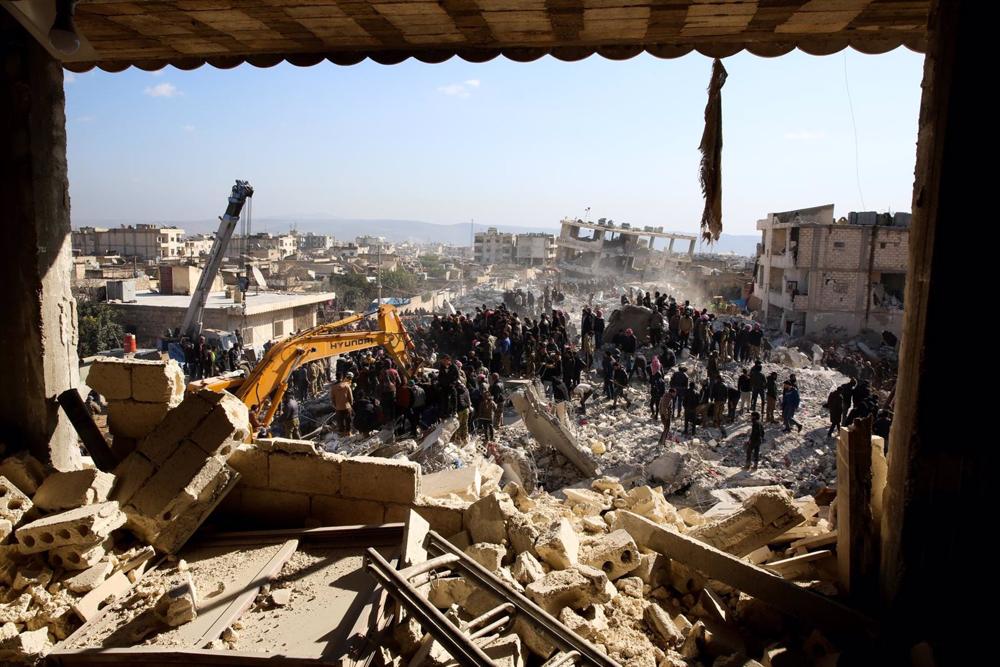
A Saudi plane loaded with humanitarian aid for the victims in Syria of last week’s earthquakes in southern Turkey, near the common border, arrived Tuesday at the airport of Aleppo (north) for the first time in ten years, after the rupture of bilateral relations following the outbreak of war in 2011.
According to information provided by the Syrian state television channel, ORTAS, the plane is carrying 35 tons of food, days after Riyadh promised to deliver aid to those affected by the devastating earthquakes, which have left more than 36,000 dead, including more than 4,500 on Syrian territory.
Two Emirati planes have also landed in Damascus and Latakia during the day, as well as planes from Armenia and Pakistan in Aleppo and Damascus, respectively. The Syrian state broadcaster said that planes carrying aid from the World Health Organization (WHO) and the United Nations Children’s Fund (UNICEF) have also arrived in the country.
The Syrian Parliament demanded on Monday the «immediate» and «unconditional» withdrawal of all international sanctions imposed on the country because of the war, after denouncing on numerous occasions that these measures applied by the United States and other Western countries limit the delivery of humanitarian aid.
The parliamentarians further stressed that «all countries and international organizations have to assume all their responsibilities» and «give what is necessary to support the Syrians affected by the earthquake in order to alleviate their suffering». On the other hand, they asked «not to politicize» the «humanitarian catastrophe caused by the earthquake in Syria».
The Syrian government on Monday opened the Bab al Salam and Al Rai crossing points on the border with Turkey for a period of three months to facilitate the entry of humanitarian aid into the country, UN Secretary-General António Guterres confirmed.
The earthquakes have so far left more than 36,200 people dead, including more than 31,600 on Turkish territory. To this death toll must be added more than 4,500 dead in Syria, including 1,414 in government-controlled areas and some 3,160 in rebel-held areas in the northwest of the country, according to data from the Syrian Civil Defense, known as the ‘white helmets’.
Source: (EUROPA PRESS)