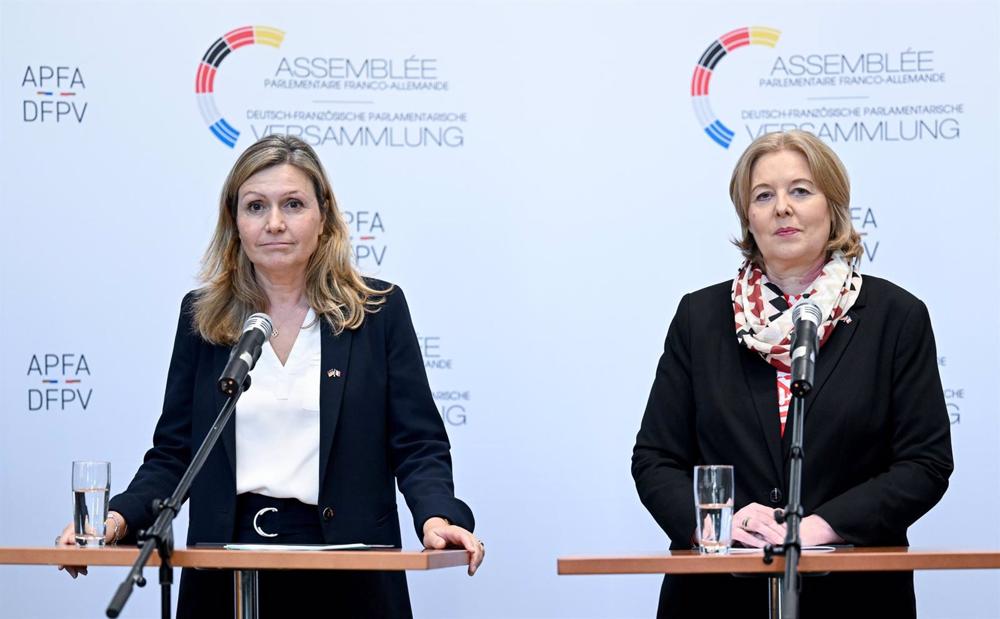
The President of the German Lower House, Barbel Bas, stressed on Monday the importance of Franco-German cooperation in times of crisis as she chaired the eighth session of the Franco-German Parliamentary Assembly in Berlin.
«We must maintain cohesion and unity in Europe, we must not allow ourselves to be divided,» signed Bas, of the Social Democrats of the. «The close Franco-German cooperation has become even more important in this situation,» he added, as reported by the DPA agency.
Bas acknowledged that Germany and France have different approaches on some issues, referring to President Emmanuel Macron’s recent criticism of Chancellor Olaf Scholz’s energy and defense policies.
However, he has pointed out that even though the two states have «different interests» they are in each case «legitimate.» «That is part of a true friendship. Our strength has always been to turn these differences into progress for Europe,» said the Bundestag President.
The president of the French National Assembly, Yael Braun-Pivet, has also referred to the discord stating that whatever difficulties may arise regarding «some issues or the assessment of the current moment,» both countries have the experience that it can be discussed and overcome together.»
Speaking before the session, German Foreign Minister Annalena Baerbock detailed that Franco-German solidarity was «the reason why the European Union was able to stand united against Russia in the face of its invasion of Ukraine», as reported by the above-mentioned agency.
«We are facing great challenges that we can only overcome together,» he added.
The Franco-German Parliamentary Assembly is composed of 100 members — 50 members of the Bundestag and 50 members of the French National Assembly. The deputies meet at least twice a year, alternately in Germany and France.
Macron and Scholz have been at the center of a series of disagreements in recent months, especially since the start of the war in Ukraine, over European defense policies and also on energy.
In fact, one of the latest disagreements between the two had Spain as a luxury spectator, as it dealt with the already frustrated MidCat project. Madrid and Berlin were betting on having the pipeline operational by 2025, while Paris rejected it.
In defense matters, Macron and Scholz have also had disagreements and, although both have the objective of reinforcing European capabilities, there is still no real progress in joint arms projects.
Germany seeks to implement a better European air defense system in collaboration with 14 other countries, among which France is not included because, according to Berlin, there is fear of a possible arms race.
However, the German government has refused to acknowledge the discord between Berlin and Paris, something that has been admitted by the French president himself, who has even pointed out that the Franco-German relationship, two of the most influential countries in the European Union, was in need of a reset.