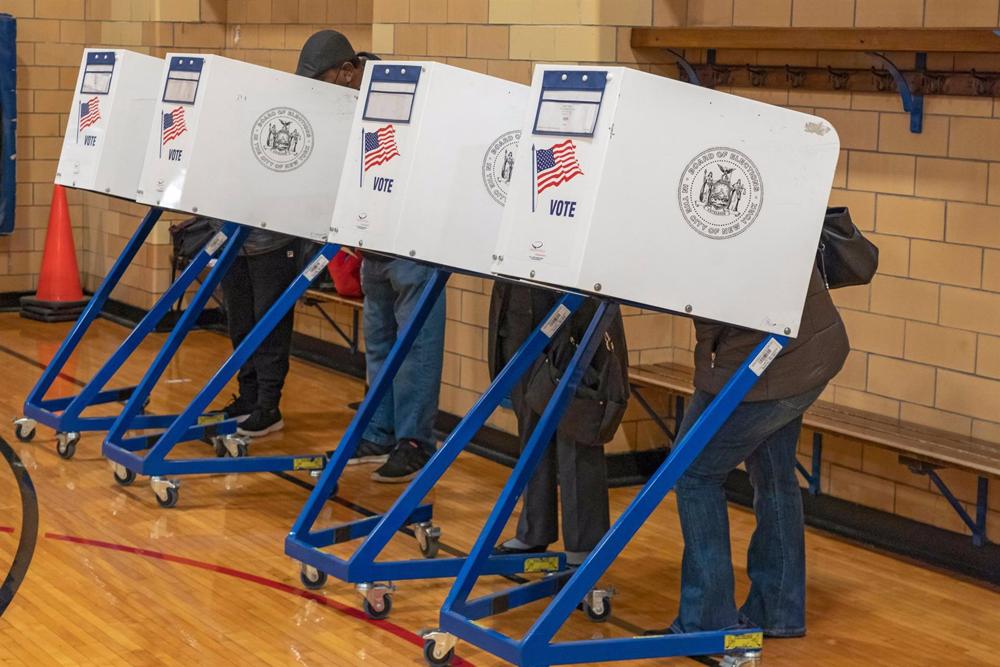
The dispute between Democrats and Republicans for control of the U.S. Congress has resulted in an even race after the end-of-term elections held on November 8, especially in the case of the Senate, where four states are key to tip the balance in favor of one of the two parties.
According to the current situation of the recount, the Democrats have 48 seats in the Senate –36 that they already controlled and twelve won in the midterm-, the same as the Republicans have in their hands –29+18–, with five still to be determined.
A party must win 51 seats to achieve a majority in the Senate, which has 100 seats, although a 50-50 split would leave control in the hands of the Democrats, since they would have the tie-breaking vote of the U.S. Vice President and Speaker of the Upper House, Kamala Harris.
In this context, the situation in Arizona, Georgia, Nevada and Wisconsin figure to be crucial in determining the final outcome, although the Democrats are counting on maintaining control in the Senate, although they could lose their majority in the House of Representatives, currently headed by Nancy Pelosi.
In the case of Arizona, Democrat Mark Kelly hopes to hold on to his seat against Republican Blake Masters, while in Georgia, Republican Herschel Walker hopes to wrest the seat from Democrat Raphael Warnock.
This case is particularly different, since in this state it would be necessary to repeat the vote if none of the candidates obtains 50 percent of the votes, a situation in which the recount is currently taking place.
On the other hand, Republican Ron Johnson expects to keep his seat against Democrat Mandela Barnes, on a night in which the Democratic Party considers to have stopped the «Republican wave» that the Republican Party expected to obtain in view of the fall in the popularity of President Joe Biden.
In this sense, the Republican senator Lindsey Graham has recognized that the polls have not derived «in a Republican wave». «That’s for sure,» he said, although he expressed his hope that the party will win 51 or 52 seats in the Senate.
Graham said in response to questions from the NBC television network on whether these results, worse than expected by the Republicans, were due to the «Donald Trump effect», in reference to a possible negative impact of the former president in several campaigns.
«Not really,» has argued the senator, who has described the ‘midterm’ as «a referendum on Biden». «If we can take back the House and get a majority in the Senate, it would be a very good night. A wave would have been to take New Hampshire and Colorado,» he concluded.
In this line, the current leader of the Republican minority in the House of Representatives, Kevin McCarthy, has assured that the Republican Party has won enough seats to control the body and has emphasized that «it is clear» that «they are going to take back the House».
«When they wake up tomorrow, we will be in the majority and Nancy Pelosi will be in the minority,» he said, according to Fox News, although many seats have not yet been assigned and the race in several of them is not decided.
THE «RED WAVE»
Although the polls predicted a comfortable majority for the Republicans in both chambers in view of the fall in Biden’s popularity and the fact that the night started with a landslide victory for Ron DeSantis in Florida, the Democrats have achieved better results than expected.
DeSantis’ victory, which could serve him as a platform for a possible candidacy for the White House in the 2024 elections -in which Trump could participate, if he finally chooses to announce his candidacy-, was followed hours later by a victory of Democrat John Fetterman in Pennsylvania, where he has snatched the seat from Mehmet Oz, who was running in the face of the withdrawal of Pat Toomey.
Steven Law, chairman of the Senate Republican super PAC, had previously acknowledged the importance of Pennsylvania, as picked up by U.S. television network CNN. «It’s a must-win race. We believe that if we win Pennsylvania, we win the majority,» he explained.
The setback suffered by the Republicans in Pennsylvania has not, however, prevented the party from taking the lead in the recount in the House of Representatives, where it currently has 198 seats – to the Democrats’ 178 and 60 seats still to be assigned. The majority threshold is set at 218 representatives.
On the other hand, the midterm results represent the best results for a party in the White House since 2002 -during the presidency of George W. Bush-, according to The Hispanic Council, which has highlighted that the Democratic Party is «strengthened at the federal and state levels».
«Traditionally, midterms have had a negative impact on the administration in office. That has not been the case in this election,» he said, before noting that «since the 2002 midterm elections with George W. Bush in the White House, the opposition party has emerged stronger from midterms.»
OTHER VOTING ISSUES Elsewhere, several states held votes during the day that resulted in, among other things, victories for abortion rights in Michigan, California and Vermont, the first to make an abortion ban permanently unenforceable since the Supreme Court’s overturning of Roe v. Wade.
Thus, Democrat Gretchen Whitmer, who has focused her campaign on her efforts to block enforcement of a 1931 anti-abortion law in almost every case, has prevailed over Republican Tudor Nixon in the state of Michigan.
Meanwhile, voters in California and Vermont have approved referendums enshrining abortion rights in their state constitutions.
In another development, the state of Maryland has legalized the recreational use of marijuana by persons 21 years of age or older, a measure that will take effect on July 1, 2023. Also, Missouri voters have approved a constitutional amendment to end marijuana use in the state, according to CNN.
By contrast, voters in Arkansas, North Dakota and South Dakota have rejected proposals and constitutional amendments to legalize cannabis possession and recreational use. In the case of South Dakota, consumption was legalized in 2020, although the governor, Kristi Noem, led efforts to overturn the legislation on the grounds that it violated the Constitution.