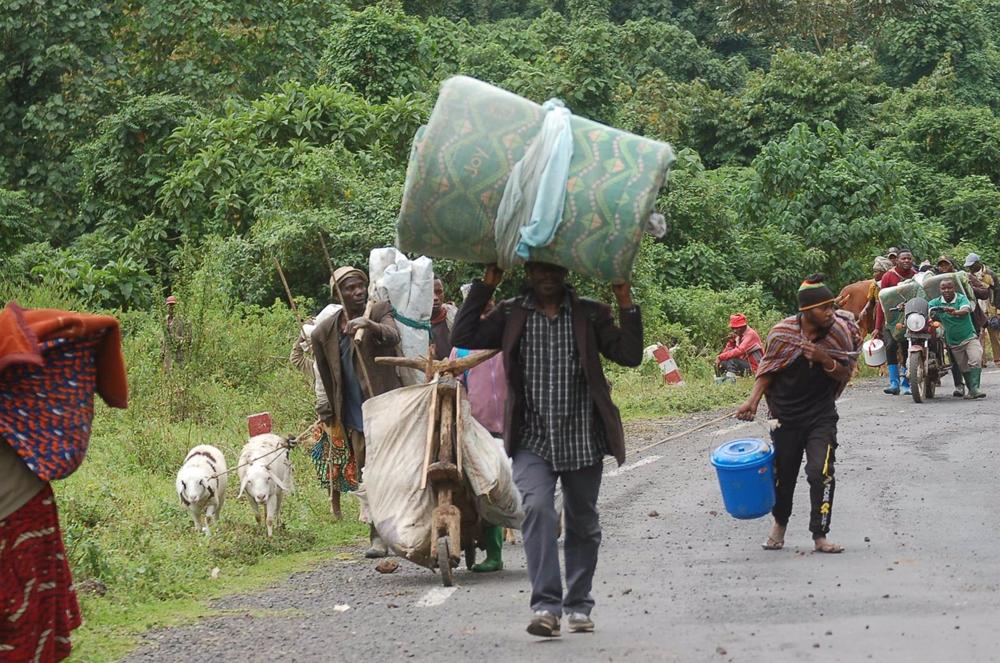
The United Nations High Commissioner for Human Rights, Volker Turk, called Tuesday for an «urgent» reduction of violence in the Democratic Republic of Congo, where more than a dozen civilians have been killed, at least 40 have been injured and more than 90,000 people have had to flee their homes.
«The security situation in eastern DR Congo is deteriorating rapidly and threatens a human rights disaster,» he said regarding clashes following advances by the rebel group March 23 Movement (M23).
In this way, he urged the parties to choose the path of peace by «embracing dialogue», as further fighting will only produce «more pain and suffering for more people». Turk also recalled the obligation to protect civilians in accordance with humanitarian law and humanitarian access to those in need.
The High Commissioner also expressed concern about the resurgence of ethnically motivated hate speech, as well as the increase in disinformation and negative discourse against the UN stabilization mission in the Democratic Republic of Congo (MONUSCO).
«The authorities must take all necessary measures to address hate speech no matter who it is directed at, and to protect journalists and other media workers, some of whom have reported being threatened and harassed since the new round of hostilities began, in an attempt to influence their reporting,» he concluded.
The M23, made up mainly of Tutsis, took up arms again in 2021 and has managed in recent days to seize the towns of Kiwanja and Rutshuru, located along the main road serving Goma, the capital of the province of North Kivu, located in the east of the country and bordering Rwanda. UN experts accused Uganda and Rwanda of supporting the rebels, although both countries denied doing so.
The M23 has been accused since November 2021 of carrying out attacks against Army positions in North Kivu, despite Congolese authorities and the M23 signed in December 2013 a peace agreement following fighting since 2012 with the Army, which was supported by UN troops.
Relations between DRC and Rwanda have gone through moments of crisis since the massive arrival in eastern DRC of Rwandan Hutus accused of having massacred Tutsis during the 1994 Rwandan genocide. After a period of diplomatic relaxation, the conflict regained intensity in May, when the Congolese government summoned the Rwandan ambassador to denounce the country’s alleged support for the M23.