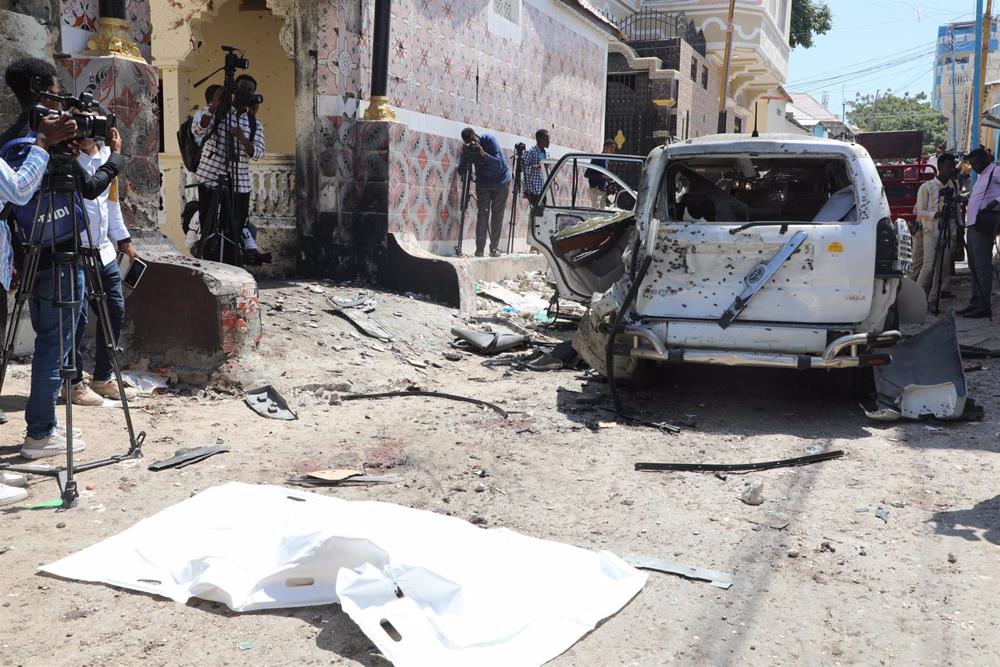
The U.S. State Department on Tuesday imposed sanctions for the first time against several individuals at the center of an arms trafficking network closely linked to the Somali branch of the Islamic State.
«The involvement of those designated today in other criminal activities, including piracy and illegal fishing, demonstrates the extent of ISIS-Somalia’s integration with illicit networks and other terrorist organizations operating in the region,» explained Assistant Treasury Secretary for Terrorism and Financial Intelligence Brian Nelson in a statement.
Specifically, among those sanctioned is Liibaan Yusuf Mohamed, a senior Islamic State intelligence activist known as Amniyat, who also made payments to the Somali branch through Liibaan General Trading – a company sanctioned in this batch – and was an active member of an illegal arms smuggling and fishing network based in Puntland.
Washington has also blacklisted Abderraman Mohamed Omar, a member of the Somali branch of the Islamic State who was considered the most active importer of illicit arms in Puntland, making transactions, mainly with actors in Yemen, worth more than two million dollars over a four-year period.
Also among those sanctioned are Mahad Isse Aden, who has used money from businessmen in Bosaso to purchase weapons and ammunition, and Isse Mohamud Yusuf, who coordinates arms shipments from Yemen to Somalia.
Another name is Osama Abdelmongy Abdallah Bakr, an Islamic State supporter in Brazil who made contacts with employees of the North Korean Embassy in the Latin American country in an effort to purchase light weapons and anti-drone technology for the benefit of the Somali branch of the terrorist group.
The Somali branch of Islamic State emerged in October 2015 after a group of militiamen from the jihadist group Al Shabaab splintered off and recruited members in eastern Puntland, where the clan of Abdulkadir Mumin, leader of this faction, originates from.
Although Mumin pledged allegiance to then Islamic State leader Abu Bakr al Baghdadi, the latter did not respond and did not appoint him as the person in charge of the extremist formation’s branch in the country. For its part, Al Shabaab responded to the split by attacking positions of the Islamic State-linked group and executing several of its members.
Mumin’s group has claimed responsibility for around a dozen small-scale attacks in Somalia, including several in Puntland during 2019, although security operations have limited its presence mainly to the Golis mountains.
In response, the U.S. Army has conducted several bombings against jihadist group positions in this area of the country. Likewise, the U.S. Africa Command (AFRICOM) has carried out dozens of air strikes against Al Shabaab, which has increased its operations in the capital, Mogadishu, and other areas in the south of the country.