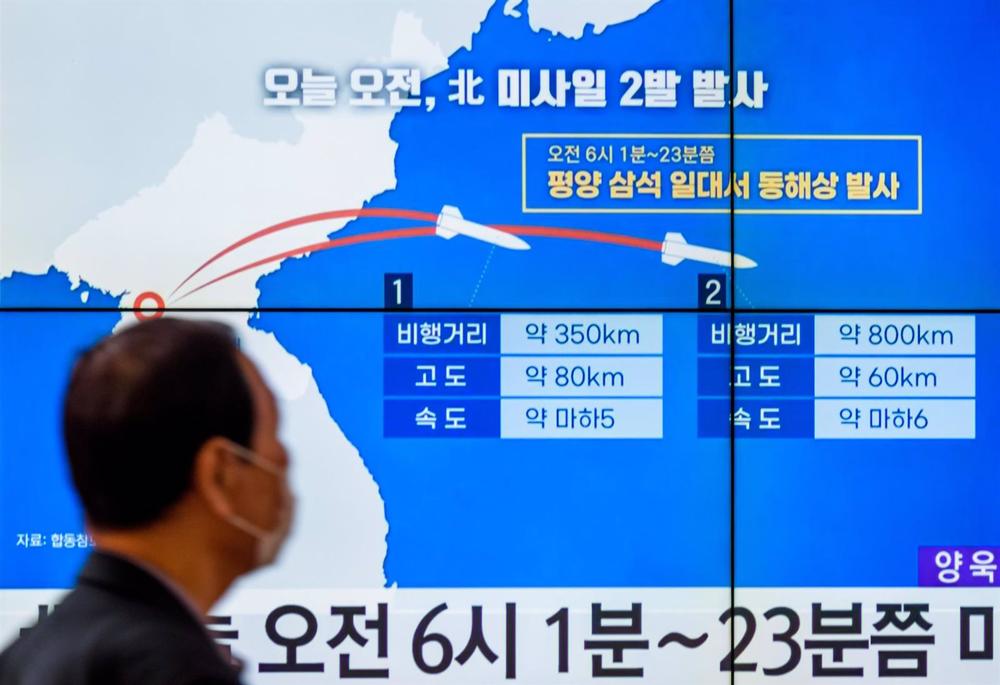
North Korea launched three ballistic missiles early Wednesday morning, one of which headed towards the South Korean island of Ulleung before finally falling into South Korean territorial waters, triggering an airborne alert in part of the country.
The missiles launched by Pyongyang have activated the air raid alert system throughout the South Korean island when one of them has crossed the South Korean maritime border, reason for which has proceeded to the evacuation of thousands of residents to basements, has collected the Yonhap agency.
«One of the three missiles fell in the high seas south of the Northern Limit Line (NLL). Another fell in waters 57 kilometers east of the city of Sokcho, and the other headed toward the island of Ulleung, near Dokdo, before falling into the international sea, prompting local authorities to issue an air raid alert,» the South Korean Joint Chiefs of Staff said.
This is the first North Korean missile launch in an area of international waters near South Korea since the division of the peninsula, a fact that the South Korean Armed Forces have described as «intolerable».
«Our military can never tolerate North Korea’s provocative act and will respond sternly in close cooperation with the U.S.,» the Joint Chiefs of Staff has maintained, according to the cited agency.
Although the South Korean Armed Forces have not yet determined the specifics of the launch such as the range, altitude and speed of the missiles, it has pointed out that they have been fired while conducting large-scale joint air exercises with the United States.
This new launch by Pyongyang further escalates tensions in the region, after North Korea has in recent weeks launched several ballistic missiles in tests banned by UN Security Council resolutions, in response to US-North Korean military maneuvers that it considers an invasion rehearsal.
The United States, as well as the International Atomic Energy Agency (IAEA), have shared their evidence that North Korea is «likely» to conduct a nuclear missile test, its first since 2017.