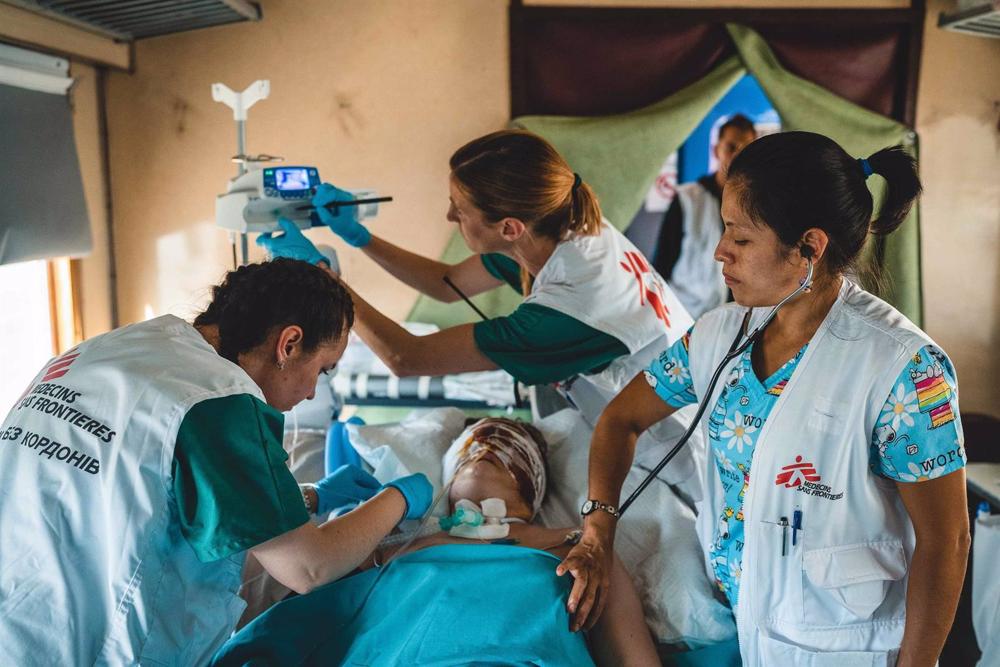
The International Committee of the Red Cross (ICRC) and Médecins Sans Frontières (MSF) warned Friday that climate change, armed conflict and health emergencies are a «deadly combination» for the most vulnerable.
«The needs are already outstripping the capacity to respond. This is a crisis of solidarity that is giving rise to a crisis of morality. The world cannot leave those suffering the most tragic consequences without support,» said MSF Switzerland Director General Stephen Cornish.
For his part, ICRC Director General Robert Mardini pointed out that «the severe combined effects» are being felt from Afghanistan to Somalia, from Mali to Yemen, so that «without decisive economic and political aid for the most vulnerable countries, the suffering will only get worse».
«Of the 25 countries most vulnerable to climate change and with the least adaptation resources, most are also affected by armed conflict. In many of these places, there is no access to basic health care. When climate shocks occur in countries with limited food, water and economic resources, lives, health and livelihoods are at risk,» they warned in a joint statement.
AFRICA, THE MOST AFFECTED CONTINENT ICRC and MSF have focused on Africa, in countries such as Somalia, which «has suffered a cycle of unpredictable droughts and floods in recent years, exacerbating an already dire humanitarian situation, further complicated by three decades of armed conflict».
«Humanitarian organizations have also responded to flooding in South Sudan and across the Sahel; devastating cyclones in Madagascar and Mozambique; and intense drought in the Horn of Africa. The climate crisis worsens the health and humanitarian crises,» they listed.
ICRC and MSF have warned of «forecasts» for the future, as food production is threatened by continuing droughts, floods or insect infestations, as well as by «increasingly extreme and powerful climatic phenomena».
«We see cyclones destroying essential health infrastructure. We see changing patterns of deadly diseases such as malaria, dengue and cholera. Armed conflict and violence increase the need for emergency health care while limiting the capacity of health facilities,» they explained.
This Molotov cocktail comes amid the effects of climate change, which has led to a 1.2 degree Celsius rise in temperature. «We are witnessing how the most vulnerable people are paying the price for a problem caused in an unconscionable way by the richest countries in the world,» they stressed.
«Further warming will lead to catastrophic consequences if urgent and ambitious mitigation measures are not taken, and if adequate support is not mobilized to enable the people and countries most affected to adapt to the growing climate risks,» they said.
«We call on world leaders to deliver on the commitments made in the Paris Agreement and the 2030 Agenda, and to take the necessary steps to ensure that the most vulnerable and conflict-affected people receive adequate support to adapt to climate change,» they concluded.