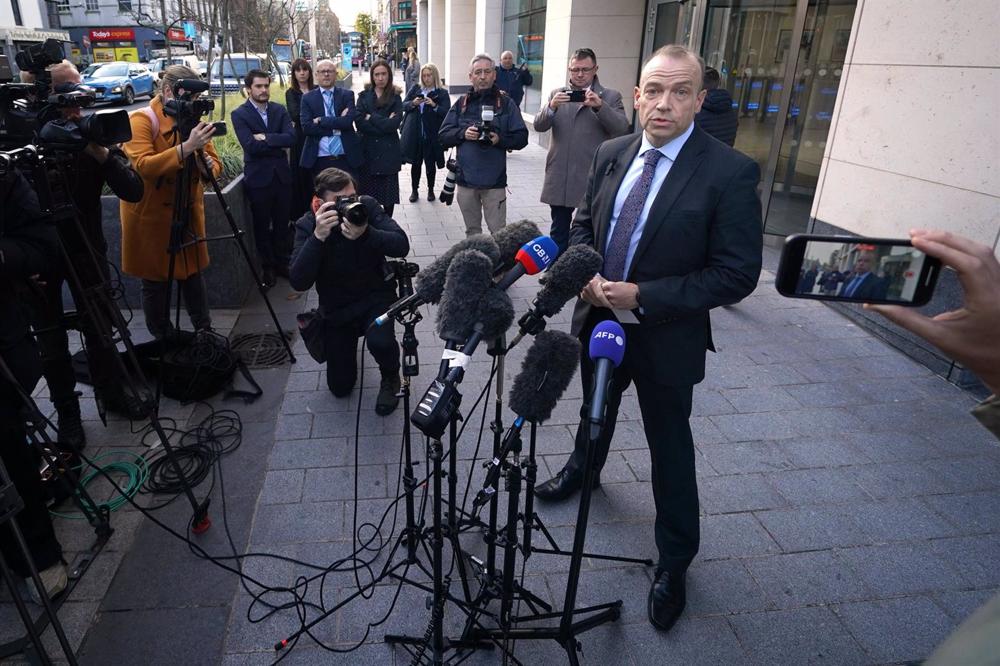
The British Minister for Northern Ireland, Chris Heaton-Harris, announced Wednesday a new measure to delay the holding of elections in the framework of the political paralysis experienced by the Stormont Assembly.
The legislation thus provides for a new deadline, set for December 8, which can be extended for at least another six weeks, meaning that the last National Assembly election in Northern Ireland could be held on April 13, 2023.
«This is intended to create the time and space necessary for talks between the Government and the EU Commission to take place and for the parties in Northern Ireland to work together to re-establish the devolved institutions as soon as possible,» he has argued, according to a British government statement.
In this sense, he has indicated that since last October 28 he has met with the different parties, at the same time that he has spoken with international interlocutors. «An election at this time would not be welcome,» he stressed.
Such a move, he explained, would allow Northern Ireland departments to support the delivery of public services, make a small number of public appointments and address budget concerns.
«People across Northern Ireland are frustrated that their members of the Legislative Assembly continue to be paid a full salary without fulfilling all the roles they were elected to do. I will therefore be asking for the support of this House to allow me to appropriately reduce (their) salaries,» he has indicated.
«Our commitment remains absolutely clear: this Government believes that this is the time for the restoration of the devolved institutions and will work towards that end with the highest priority,» Heaton-Harris added.
Finally, she stressed that «the Government is absolutely clear that the principle of consent governs Northern Ireland’s constitutional position.» «We will not support any agreement that is incompatible with that principle,» she concluded.
The Stormont Assembly has ahead of it a process to recover the institutionality of the Northern Irish self-government now with the republican party Sinn Féin at the head, after its victory in last May’s elections.
The Democratic Unionist Party (DUP) refuses to return to the Executive until the dispute over the Northern Ireland Protocol is resolved on its terms, so the process has been blocked for months after a failed vote to nominate the Stormont Speaker and Deputy Speaker.
Sinn Féin, led by Michelle O’Neill, won 27 of the 90 seats in the Northern Ireland Assembly and is currently the leading political force ahead of the DUP (25) and the Alliance Party (17). The Ulster Unionist Party has nine seats and the Social Democratic and Labor Party has eight seats.