The European Commission estimates that the Spanish economy will grow by 4.5% in 2022, half a percentage point above the summer forecast, while the growth forecast falls to 1% for 2023 and rises to 2% for 2024.
However, Spain would avoid a technical recession that will affect the rest of the European Union (EU) by preventing Gross Domestic Product (GDP) growth from contracting for two consecutive quarters to 0% in the first quarter of 2023.
It also increases the forecast for a rebound in Spanish inflation to 8.5% for the current year, compared to the 8.1% estimated in July, but foresees a reduction to 4.8% for 2023 and 2.3% for 2024.
This figure is, however, below the 9.3% EU inflation forecast, which is expected to fall to 7% across the European Union by 2023 and to 3% in 2024.
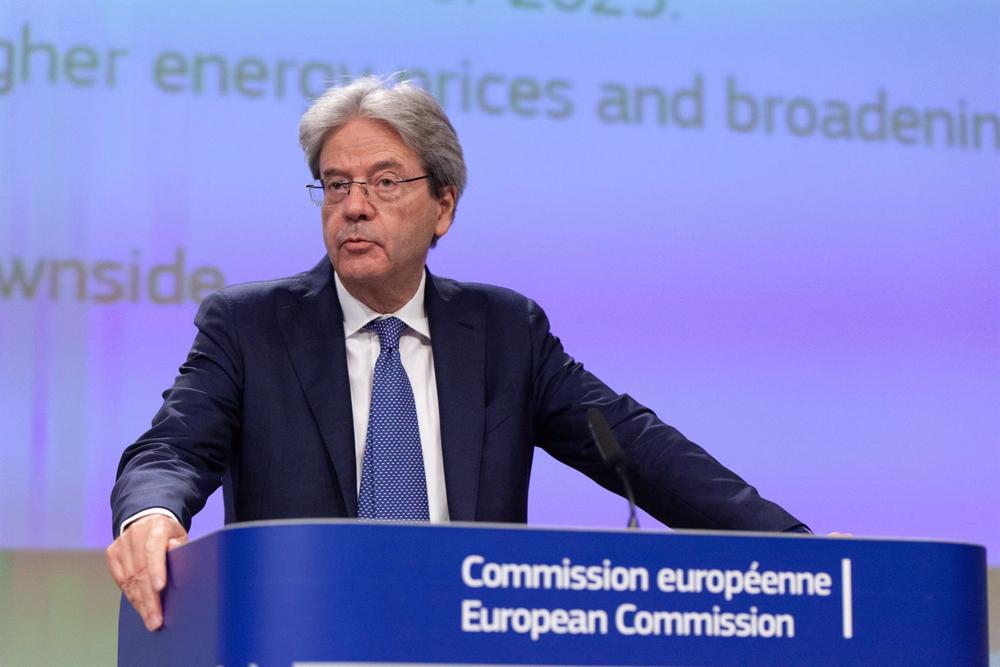
Economy Commissioner Paolo Gentiloni said he expects the EU economy «to contract in both the current and the first quarter of 2023, a technical recession that will be widespread across all demand components, but also across countries, with most Member States experiencing two consecutive quarters of contraction.»
As for the Spanish economy, Gentiloni said that it is expected to experience a slowdown in growth next year. In addition, pressures from high energy prices are expected to partially abate from mid-2023, allowing for a gradual pick-up in activity thanks to a moderate revival in private consumption and a further normalization of tourism.
Similarly, this expansion is expected to be more robust in 2024, also thanks to the revival of domestic and external demand, and real GDP is expected to grow by 4.5% in 2022, before slowing to 1.0% in 2023, and rising to 2.0% in 2024.
Brussels’ updated economic forecast points to an increase in Spain’s Gross Domestic Product (GDP) of 4.5% in 2022, half a percentage point above the forecast presented last July, but 2.2 percentage points below the spring forecast, when it stood at 6.3%.
Spain is also among the countries with the greatest decrease in the unemployment rate, together with Lithuania, Sweden and Italy, from 13.3% to 12.4%.
With regard to the European Union (EU) as a whole, Brussels raises its growth forecast to 3%, compared to 2.7% in the summer forecast, but reduces the forecast for 2023 from 1.5% to 0.5%.