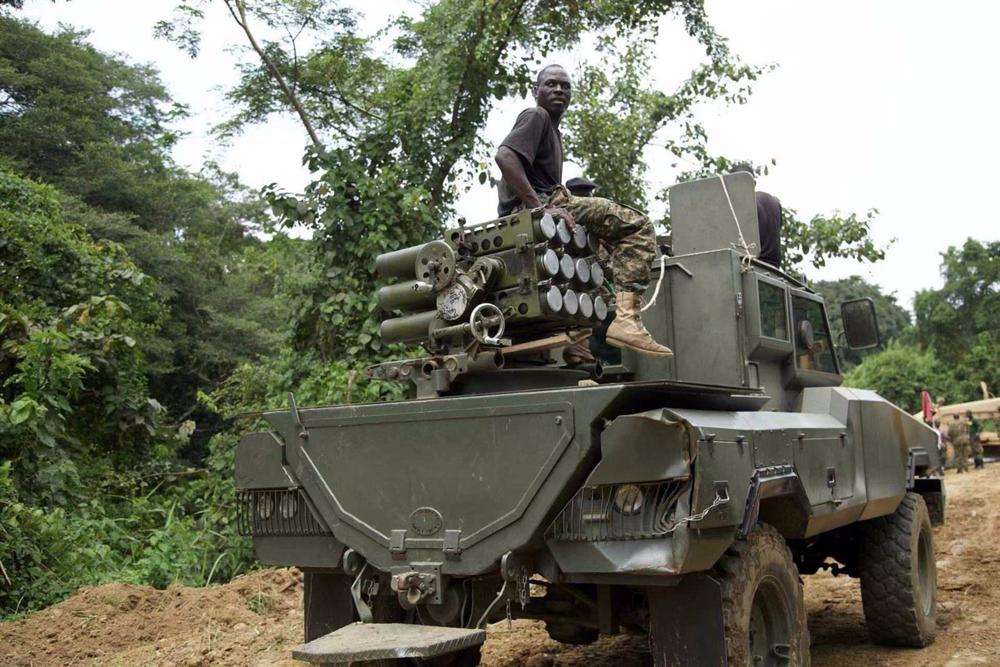
The rebel group March 23 Movement (M23) has stormed this Wednesday in the village of Nyamilima, in eastern Democratic Republic of Congo (DRC), a day after taking control of another village in the province of North Kivu.
Sources quoted by the Congolese news portal Actualité have indicated that the rebels have arrived in Nyamilima from Binza, in the territory of Rutshuru, taking advantage of the fact that the army is not deployed in the area.
These sources specified that the M23 used «a secondary route» to reach the locality and said that the rebels passed through «a post of the Armed Forces of the DRC abandoned for more than two and a half years and recently occupied by self-defense forces».
The M23 advance comes a day after local sources quoted by Radio Okapi said the group had taken control of Kisharo, in the midst of contacts for its withdrawal and disarmament, mediated by the East African Community (EAC).
The M23 had told the East African Regional Force (EACRF) that it would withdraw by January 5 from the towns of Rumangabo and Kishishe, after having withdrawn from Kibumba. However, DRC authorities have been skeptical about these announcements.
For its part, the Network against Terrorism in DRC (RCT), which brings together about 150 civil society organizations, has applauded a recent report that the Rwandan authorities maintain a «direct intervention» in the African country through their support to the M23.
In this sense, it has asked the International Criminal Court (ICC) to open an investigation for alleged human rights violations in the east of the country and the imposition of sanctions against Kigali for its support to the rebels, according to Radio Okapi.
The RCT has accused the group of using child soldiers, attacking civilian structures, committing murder, rape, arbitrary detention and torture, which would amount to war crimes, crimes against humanity and genocide, according to these organizations.
The M23 has been accused since November 2021 of carrying out attacks against Army positions in North Kivu, despite the fact that Congolese authorities and the M23 signed a peace agreement in December 2013 following fighting since 2012 with the Army, which was supported by UN troops.
The situation has led to a spike in tensions between DRC and Rwanda, as Kinshasa accuses Kigali of supporting the rebels. Kigali, for its part, denounces Kinshasa’s support for the Democratic Forces for the Liberation of Rwanda (FDLR), founded and composed mainly of Hutus responsible for the 1994 genocide in Rwanda.
Source: (EUROPA PRESS)