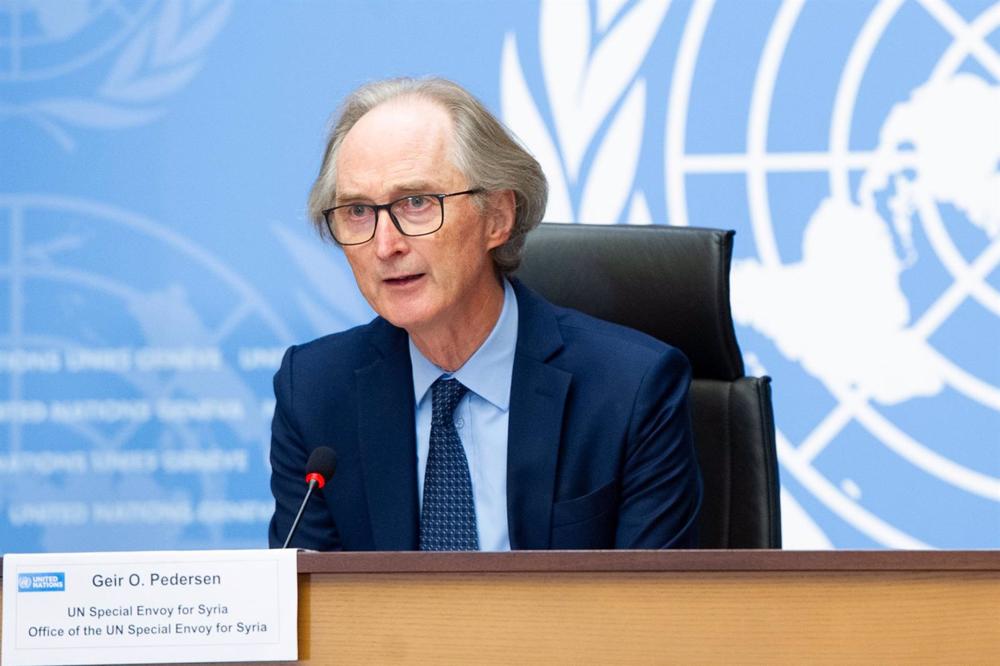
The United Nations special envoy for Syria, Geir Pedersen, on Monday stressed the need to «work in all areas of Syria» to help those affected by last week’s earthquakes and acknowledged «particular challenges» in providing support to the population in areas in the northwest of the country under the control of rebel groups.
Pedersen, who met in Damascus with Syrian Foreign Minister Faisal Mikdad, said that «the UN will do everything possible to support the Syrian people in this crisis» and expressed his «satisfaction» with the «assurances» of the authorities about their «support for the work being done throughout Syria».
«As you know, there have been particular challenges in the immediate aftermath of the earthquake in providing support in northwest (Syria). We believe it is being corrected, but of course it cannot fix all the problems we had from the beginning,» said the UN envoy, who stressed that «aid is getting through.»
«It is important, as I said, that we get more resources and support in operations across front lines and across the border (with Turkey).» «Our focus is to help the Syrian people,» he has reiterated, according to a transcript of his remarks provided by his office through its website.
For his part, Mikdad stressed «the need not to politicize the humanitarian aspect» and «respect the sovereignty and territorial integrity of Syria,» before thanking Pedersen for his «solidarity with Syria» in the face of this «unprecedented humanitarian catastrophe,» as reported by the Syrian state news agency, SANA.
The Syrian Foreign Minister has also shown Damascus’ willingness to «give all possible support to the people affected by the earthquake» and «deliver humanitarian aid to the victims in all areas, without discrimination», while betting on «working closely» with UN agencies to address the «catastrophic consequences of the earthquake».
Mikdad also called for an end to «unilateral measures» against Syria, in reference to the sanctions applied by the United States and other European countries. Damascus has denounced on numerous occasions that these sanctions affect the delivery of humanitarian aid.
In another order of things, the UN Humanitarian Coordinator, Martin Griffiths, has moved during the day to the city of Aleppo to analyze the situation after the earthquakes, which have left more than 36,000 dead in both countries, including more than 31,600 in Turkish territory.
The UN has confirmed that this Monday six trucks have crossed the border with Turkey to deliver aid to the victims in Syria, amid complaints about the lack of care for those affected in the northwest of the country, an area controlled by various rebel groups, including Hayat Tahrir al Sham (HTS), a terrorist organization inherited from the al Nusra Front that was once an affiliate of Al Qaeda in Syria.
The Syrian American Medical Society (SAMS), which provides medical assistance in rebel-held areas, has stated that «the lack of shelter and food after the earthquake and premature return to unstable structures can have catastrophic health effects on the vulnerable population.»
Abu Mayid, a volunteer with the Syrian Civil Defense, known as ‘white helmets’, has stated that people prefer to return to damaged houses rather than wait for camps being erected in Idlib. «There is a lack of everything and a cross-border aid delivery will not meet the needs of the displaced,» he has criticized in statements to the DPA news agency.
Griffiths himself acknowledged on Sunday that the people of northwestern Syria have been left «abandoned» in the absence of international aid to alleviate the consequences of the devastating quake. «We have failed the people of northwest Syria. They feel abandoned, and rightly so, in search of international aid that has not arrived» he stressed through his account on the social network Twitter.
Source: (EUROPA PRESS)