The Heads of State and Government of the European Union (EU) on Thursday called on the European Commission to specify the measures to be implemented to try to win the ‘green’ race against other international competitors such as China or the United States, which want to inject subsidies into their clean industries, and among which they urge to make State aid more flexible in a temporary framework and limited to strategic areas.
For its part, Brussels has offered to speed up the availability and use of funds until 2025 and in the specific areas of wind energy, heat pumps, solar energy, clean hydrogen and storage.
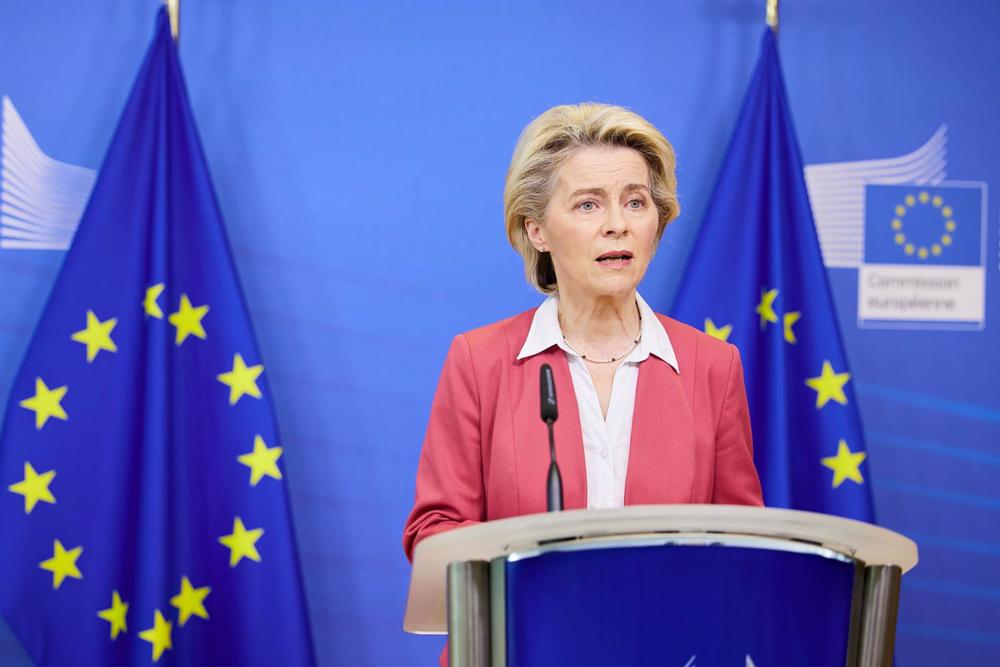
This is the approach that the president of the Community Executive, Ursula von der Leyen, has put forward to the leaders at the summit held in Brussels and with which she intends to respond to the demands of the Twenty-Seven that the flexibility of the funds be made on the basis of criteria of temporality and concreteness.
In the short term, the Commission maintains its strategy of using the funds already available and advocates spending them more quickly and easily with a reduction in bureaucratic procedures, as the EU-27 already have at their disposal a sum amounting to 270,000 million euros in aid for the ecological transition.
In addition to this item, there are 26 billion euros to mobilize investment in clean technologies and a further 40 billion euros from the Innovation Fund to be spent over the next decade.
In the medium term, Brussels is committed to the creation of a European Sovereignty Fund to add new funds to those already available and to focus on injecting capital into the production of emerging clean technologies, which the Commission will outline before the summer.
On this point, Spain agrees with Germany in calling for a relaxation of the existing aid before disbursing new capital at the expense of the current funds, while others, as is the case of France, are asking for a more «broad scope», according to diplomatic sources.
For its part, France, which insists on the extension of the margin of thresholds for receiving subsidies, is the partner with which Spain and Germany differ the most in this respect, rejecting the increase to 100 million proposed by Macron due to the risk of fragmentation of the Single Market.
However, Macron and Scholz did agree in stressing that what the EU is demanding from the United States are also exemptions comparable to those enjoyed by partners such as Canada or Mexico, in order to avoid entering into a «subsidy war» that would weaken the European market.
But if there is one thing the EU-27 agree on, it is their commitment to guarantee that the simplification of procedures is carried out on equal terms and ensures a fair distribution of funds to prevent Member States such as France and Germany, with greater capacity to disburse aid, from benefiting to the detriment of other countries with less financial muscle.
The Green Deal Industrial Plan, as Brussels calls it, aims to cover the regulatory environment, financing, worker skills and international trade and will focus on streamlining permits to facilitate investment in crucial sectors along the entire supply chain in order to achieve the goal of zero net emissions.
OTHER REQUESTS OF THE TWENTY-SEVEN In their conclusions, the leaders stress that in addition to simple, predictable and clear framework conditions for investment, access to relevant critical raw materials must be ensured, including by diversifying supply and recycling raw materials to promote the principles of the circular economy.
They also call for the forthcoming reform of the electricity market design to contribute to improving the EU’s competitiveness and call for the potential of the European Investment Bank (EIB) to be «exploited to the full», as well as for rapid progress to be made on the revision of fiscal rules.
The EU-27 have also called for EU instruments, such as Major Projects of Common European Interest, to be implemented efficiently by increasing transparency and streamlining procedures, in particular by speeding up the design and evaluation phases.
Finally, EU leaders consider it necessary to further exploit the full potential of the Single Market and reiterated their invitation to the Commission to present an EU-wide strategy to boost competitiveness and productivity, an issue the EU-27 will return to at their next meeting in March, when Brussels will present a legislative proposal in line with Member States’ input.
Source: (EUROPA PRESS)