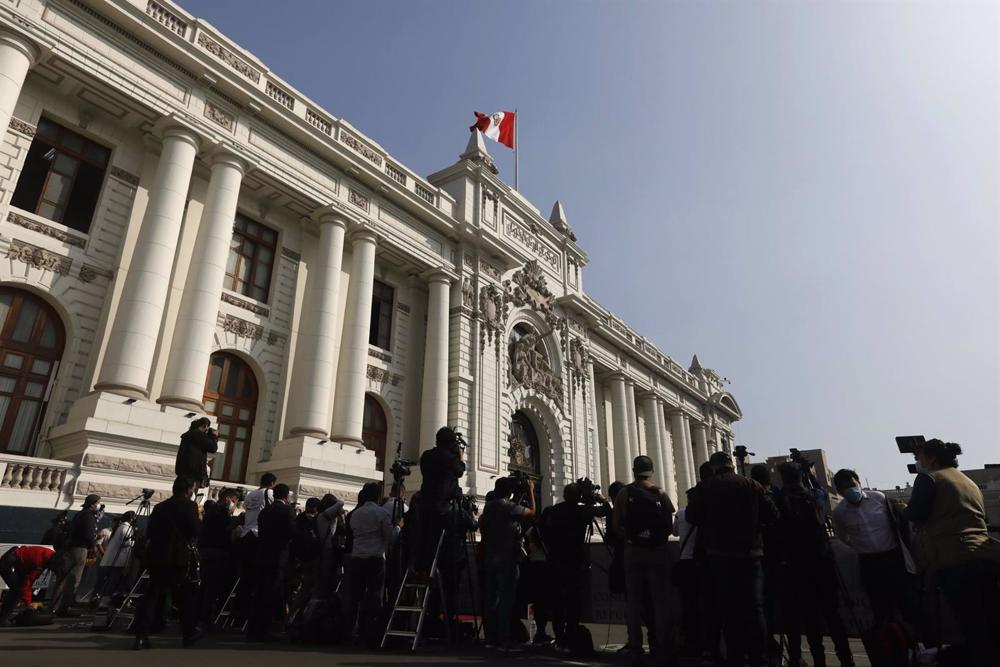
The president of the Peruvian Constitutional Court, Francisco Morales Saravia, has estimated that the jurisdictional claim on whether it is up to the Executive or the Congress to interpret the denial of confidence will be resolved by March at the latest.
In the meantime, he pointed out, President Pedro Castillo will not be able to consider that the «flat rejection» by the Chamber was the first confidence denied.
«This is a competence process, a conflict of competences, then here what is under discussion is who has the competence to interpret, to define, if there has been the denial of confidence. The Congress approved to present this competence lawsuit and we have admitted it and at the same time present a precautionary measure,» he explained in an interview with RPP radio station.
The regulation grants a term of 30 working days for the parties to answer the notification, after which the Constitutional Court has another 10 days to convene a public hearing where the opposing positions will present their reasons, after which it has 30 more days to resolve, he explained.
«Fulfilling the maximum, more or less we are talking about March 8; however, after the public hearing the case is already expedited to be evaluated. As those requesting precautionary measures say, there are many variables because the Executive maintains its competences to present its confidence issues», he has indicated.
Thus, he has detailed that the court has taken into account the statements of the former president of the Council of Ministers Aníbal Torres about a possible closing of the Congress, but that the argument of taking the first denial as a refusal to present a question of confidence, was the main one.
This week the plenary of the Court issued a precautionary measure in favor of the Congress while the decision on the competence demand arrives, a measure that it considered adequate to avoid «the serious institutional effects» that could derive from the competence after the «flat rejection».