The year 2022 was the year of the beginning of Russia’s invasion of Ukraine, but the local and global consequences of this conflict in the center of Europe have not prevented other milestones from being achieved all over the planet, which, looking back, UN agencies and NGOs also want to highlight.
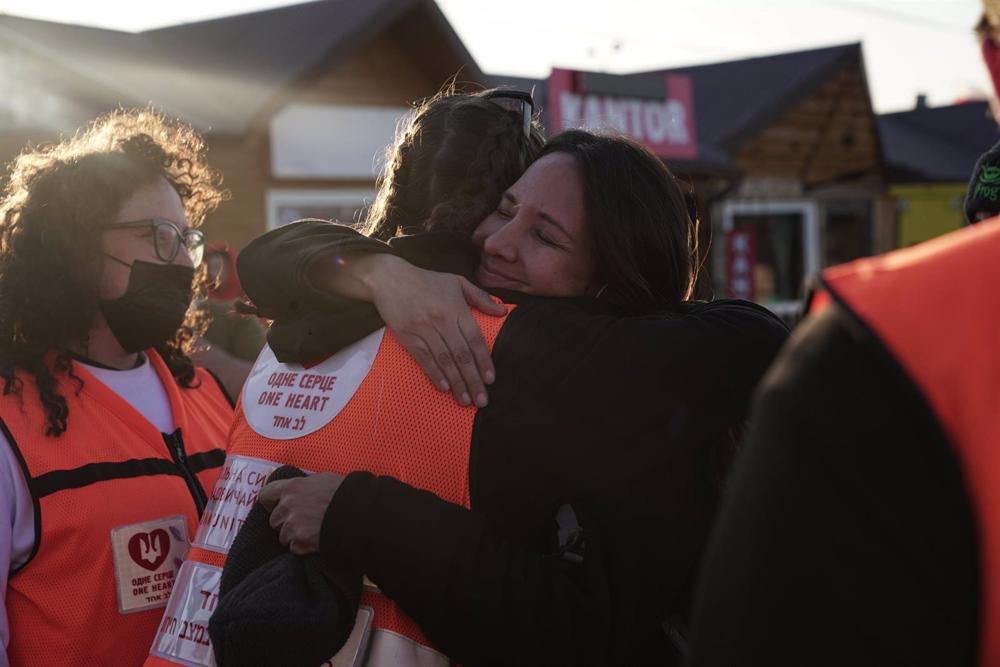
In fact, the UN High Commissioner for Refugees (UNHCR) welcomes the «exemplary» and «unprecedented» response at European level to the war in Ukraine, for example with the activation for the first time of a temporary protection directive from which Ukrainians who fled their country en masse after the outbreak of the conflict in February have been able to benefit.
«This mechanism allows access to immediate protection and grants work and residence permits to Ukrainians, stateless persons and third-country nationals with legal residence in Ukraine who are unable to return to their country,» emphasizes the organization’s spokesperson in Spain, María Jesús Vega, who is now asking to go further. She hopes to «take note» of this «rapid and agile» response and apply it to other displacement contexts as well.
She also applauds the «solidarity» of a population that «literally turns» to respond «in a thousand ways» to emergencies such as the one in Ukraine. Or that of administrations at all levels that mobilized in record time to assist the refugees.
«This very positive experience has taught us that the processing and response to refugees can be simplified and expedited when there is will and resources, when there is coordination among all actors and administrations and political considerations are put aside,» he points out.
The «immense wave of global solidarity» is also the global good news in the eyes of Save the Children, in a year marked by a war, that of Ukraine, which has had «extremely serious» consequences for the population, in the words of the NGO’s Director of International Cooperation, Vicente Raimundo.
In this sense, he recalls that it is all a matter of will: «The social mobilization that we have seen in this regard in 2022 has been unprecedented, as well as the response of Europe, which has opened its borders to the population fleeing the conflict, demonstrating that when there is political interest, shelter is not a problem».
PROGRESS IN AFRICA World Vision, on the other hand, highlights the ceasefire agreement signed in November between the Government of Ethiopia and the Tigray People’s Liberation Front (TPLF), insofar as there are millions of people who «urgently need support» in the northern part of the African country.
The communications director of World Vision Spain, Eloisa Molina, says that the NGO is «happy» about this milestone and advocates working «immediately» to expand activities and move towards a «lasting peace». «We want this to be a permanent cessation of violence,» says Molina.
In the northern Nigerian state of Zamfara, children are no longer dying from lead poisoning, the result of a therapy initiated by Médecins Sans Frontières (MSF) after more than 400 children died in just six months in several villages eleven years ago due to environmental pollution from mining.
Project coordinator Benjamim Mwangombe recalls that «people transformed the villages into processing sites and polluted the environment for many years,» both the air and the land. For this success, the involvement of local communities has been key, also with a view to not repeating the same situation in the future.
With the focus on Europe, the head of Advocacy and Studies of the UN Children’s Fund (UNICEF) in Spain, Cristina Junquera, highlights the progressive implementation of the European Child Guarantee. In Spain, the National Action Plan for its implementation was approved in July.
As Junquera points out, this initiative advocates providing all children and adolescents in the EU with six basic rights: «education and child care, education and extracurricular activities, at least one healthy meal per school day, health care, adequate housing and healthy food».
At the same time, however, he warns that not everything is done and «the most important part of the plan» remains, i.e., putting it into practice and achieving its goals. To «keep the bar high» and to ensure that «ending child poverty is not diluted in the long run», it is necessary for all actors to participate and coordinate.
The Deputy Executive Director of UN Women, Anita Bhatia, agrees with the European focus, highlighting in particular the EU directive to promote gender equality at the top of business, as it «will help to break the glass ceiling that still hinders women’s progress today and will also increase transparency in recruitment processes».
«Increasing the presence of women at the top of companies is important, on a symbolic level and in its own right, because the evidence shows that it is good for the companies themselves and the economies,» she says. The UN estimates that companies with at least 30 percent female workers and more than 20 percent in management positions are 1.4 times more likely to have sustained, profitable growth.
In addition, Bhatia stresses that women leaders are also «role models» to open the «leadership path for others». Not surprisingly, she adds, «86 percent of women say that when they see more women in leadership, they feel encouraged that they can get there on their own.
CLIMATE JUSTICE Plan International, for its part, values positively the decision of the UN COP27 summit on the establishment of a fund for loss and damage to advance climate justice and support developing countries, a «historic decision» that comes «after years of effort» and whose implementation must be «urgent».
Children and adolescents figure as agents of change in the face of an emergency that requires immediate action. The general director of Plan International, Concha López, calls on all countries, «particularly the Spanish government», to adopt «ambitious» climate policies that take into account the rights of children and to adopt measures to anticipate and mitigate the impacts of the crisis.
Source: (EUROPA PRESS)