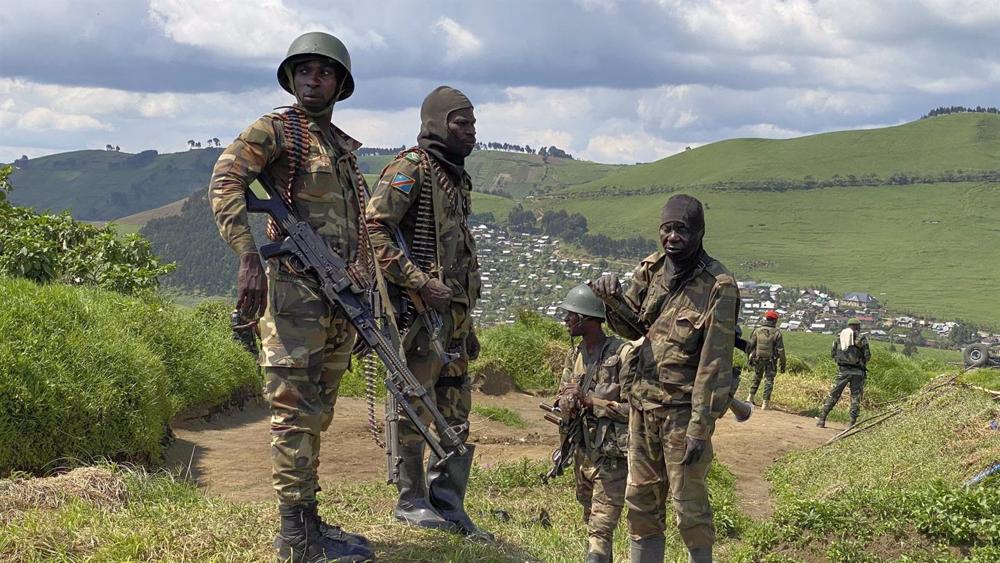
The rebel group March 23 Movement (M23) has taken control of the Congolese city of Kitshanga, in the province of North Kivu (east), after several days of clashes with the Army of the Democratic Republic of Congo (DRC).
«Yes, we control Kitshanga and its neighborhoods», said Willy Ngoma, military spokesman of the group, in declarations to the British television channel BBC shortly after the Congolese radio station Radio Okapi reported the entry of the rebels in the locality.
Sources quoted by the radio station have indicated that part of the population has moved to the base of the United Nations Mission in DRC (MONUSCO) in search of security, in the midst of the recent advances of the M23 in the face of the upsurge of the fighting in the area.
The Congolese authorities, who have denounced that the M23 did not proceed to complete its withdrawal on the dates fixed at the mini-summit in Luanda and launched operations in the area, have not pronounced themselves for the moment on the situation in Kitshanga.
For its part, MONUSCO condemned on Thursday «the military offensive of the M23 in the territory of Masisi» and put the number of displaced persons who have taken refuge in its base in Kitshanga at 450 persons, «including women and children».
«Our ‘blue helmets’, who are physically protecting them, have also given immediate assistance in the form of tents, food, water and first aid,» he said on his account on the social network Twitter, where he called on the rebels to «cease all hostilities and withdraw from the occupied areas, in line with the ‘road map’ set out in the final communiqué of the Luanda mini-summit.»
The rebel group on Thursday accused the DRC of «creating» chaos through the «externalization of the conflict» and has reiterated its allegations about the use of «mercenaries» by Kinshasa, while accusing MONUSCO of being the «pillar» of government forces and their allied militias.
«The M23 condemns the continued shelling of densely populated areas by the coalition with the help of MONUSCO. The M23 continues to defend itself in a professional manner and protect the civilian population and their belongings and will spare no effort in dealing with the threat, wherever it comes from,» he said.
The group issued a statement late Thursday denouncing that DRC is «preparing a genocide in Ituri, North Kivu and South Kivu.» «Unfortunately, the worst and the most feared is happening under the watchful eyes of the world,» said M23 political wing spokesman Lawrence Kanyuka.
«There is a genocide underway against the Congolese Tutsis in Kitshanga, Burungu, Kiloliwre and surrounding areas by the DRC government coalition and its killing machine, the Democratic Forces for the Liberation of Rwanda (FDLR),» he stressed. The FDLR is an armed rebel group founded and composed mainly of Hutus responsible for the 1994 genocide in Rwanda.
«Therefore, the M23 is compelled to intervene and stop another genocide in the Great Lakes region of Africa, as the world fails to assist a community under threat of extermination,» said Kanyuka, who recalled the genocide of Tutsis in Rwanda.
THE CONFLICT WITH THE M23 The M23 is a rebel group formed mainly by Congolese Tutsis and operating mainly in the province of North Kivu. Following a conflict between 2012 and 2013, DRC and the group signed a peace agreement in December. In the fighting, the DRC Army was supported by UN troops.
The group launched a new offensive in October 2022, which intensified in November, sparking a diplomatic crisis between the DRC and Rwanda over its role in the conflict. UN experts pointed in December to the existence of «substantial evidence» of a «direct intervention» of the Rwandan army in the conflict.
They also highlighted collusion between the Congolese Army and various armed groups, including the Democratic Forces for the Liberation of Rwanda (FDLR) and the Mai-Mai, to combat the M23, including the proposal by armed groups to «mobilize 600 fighters» to reinforce the ranks of the Armed Forces.
Rwanda has accused the DRC of supporting the FDLR and of using the Mai-Mai militias — Congolese nationalist militias formed to defend their tribal territory against the numerous rebel groups active since the 1990s — in the context of the conflict. He has also denounced discrimination and acts of hatred against the Tutsi minority in the neighboring country.
Source: (EUROPA PRESS)