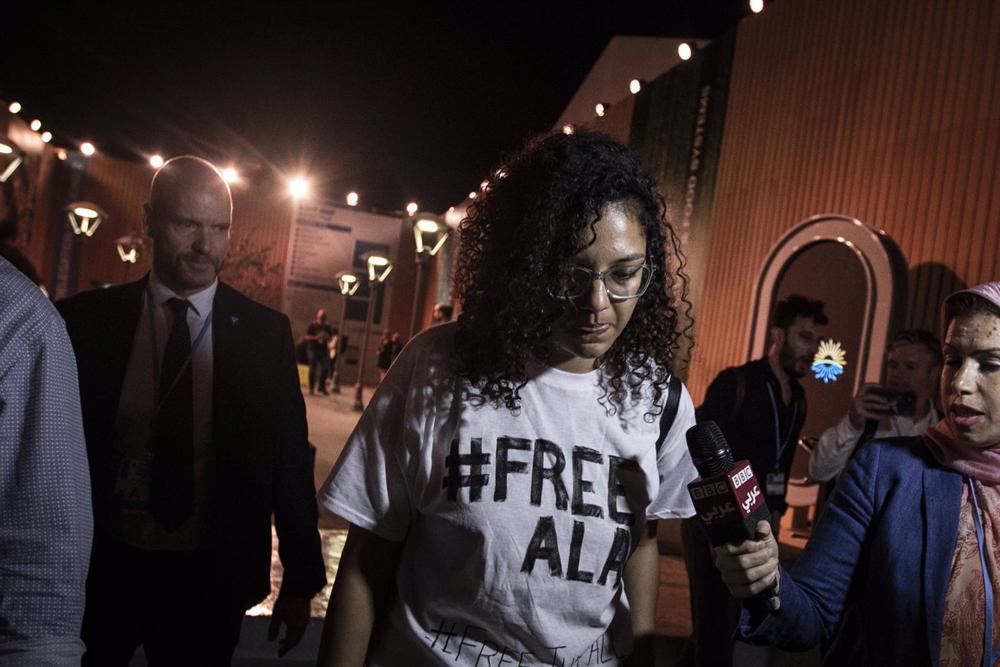
Egyptian activist Alaa Abdelfatah has ended the hunger strike he began more than 200 days ago to demand his release, according to his sister and fellow activist, Sanaa Seif.
Abdelfatah has sent his family a letter in which he confirms having ended his hunger strike and asks them to bring him a cake to celebrate his birthday on Thursday, the day when his relatives are scheduled to visit him.
«The most important thing is that I want to celebrate my birthday with you on Thursday. I haven’t celebrated anything for a long time, and I want to celebrate with my cellmates, so bring me a cake and provisions. I have broken my (hunger) strike,» reads Abdelfatah’s missive picked up by Seif in a Twitter post.
Abdelfatá’s relatives have denounced in recent weeks the lack of information on the activist’s state of health, until Monday when Seif herself also reported on social networks that they had received a letter from her brother, something she celebrated as a «proof of life.»
Abdelfatá intensified his hunger strike on November 6, when he also stopped drinking water as an attempt to put further pressure on the authorities for his release, coinciding with the start of the Climate Summit (COP27).
Days later, Cairo indicated that he had undergone a «medical intervention» and assured that he was in good health. On Monday, Abdelfatá confirmed in the aforementioned letter that he had resumed drinking water.
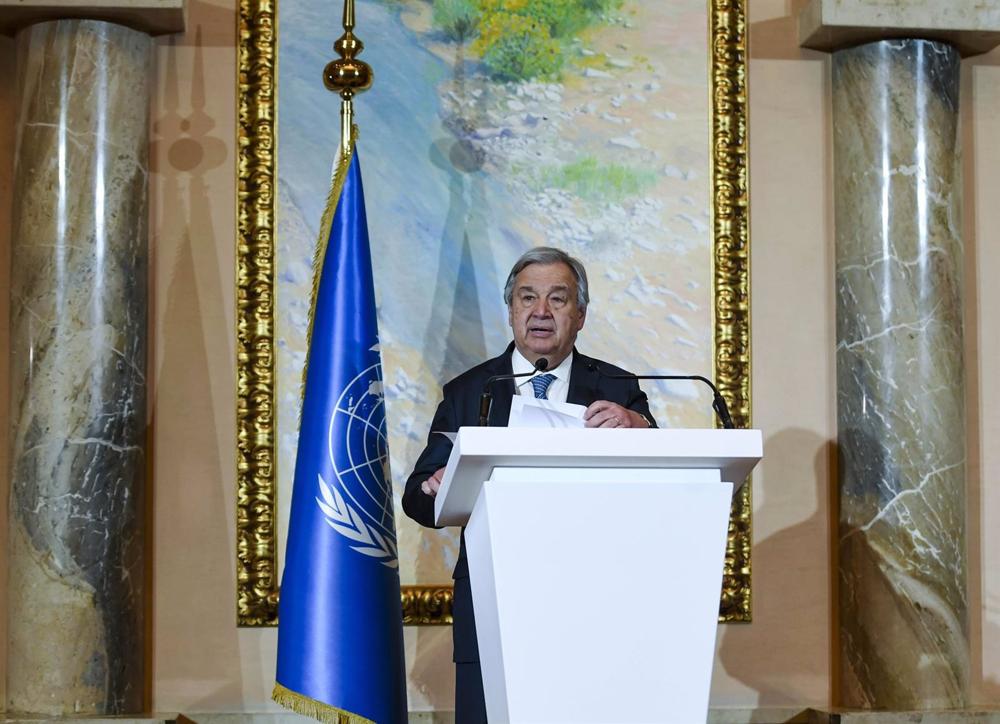
The United Nations High Commissioner for Human Rights, Volker Turk, last week called for the «immediate» release of Abdelfatah, a leading Egyptian blogger and one of the main figures of the popular uprising against Hosni Mubarak in 2011 in the framework of the ‘Arab Spring’.
The activist has been in prison for nine years and in 2021 was sentenced to another five-year jail term for «spreading false news», charges that various NGOs have called trumped up.
The current Egyptian president, Abdelfatá al Sisi, came to power in a coup in July 2013 which he led after a series of mass demonstrations against the then president, the Islamist Mohamed Mursi, the first democratically elected president in the country and who died in 2019 during a court hearing against him following his arrest after the uprising.
The leader has promoted a broad campaign of repression and persecution against opponents, both liberal groups and Islamist organizations – going so far as to declare the Muslim Brotherhood a terrorist organization – an initiative that human rights groups have denounced as the most serious in recent times.