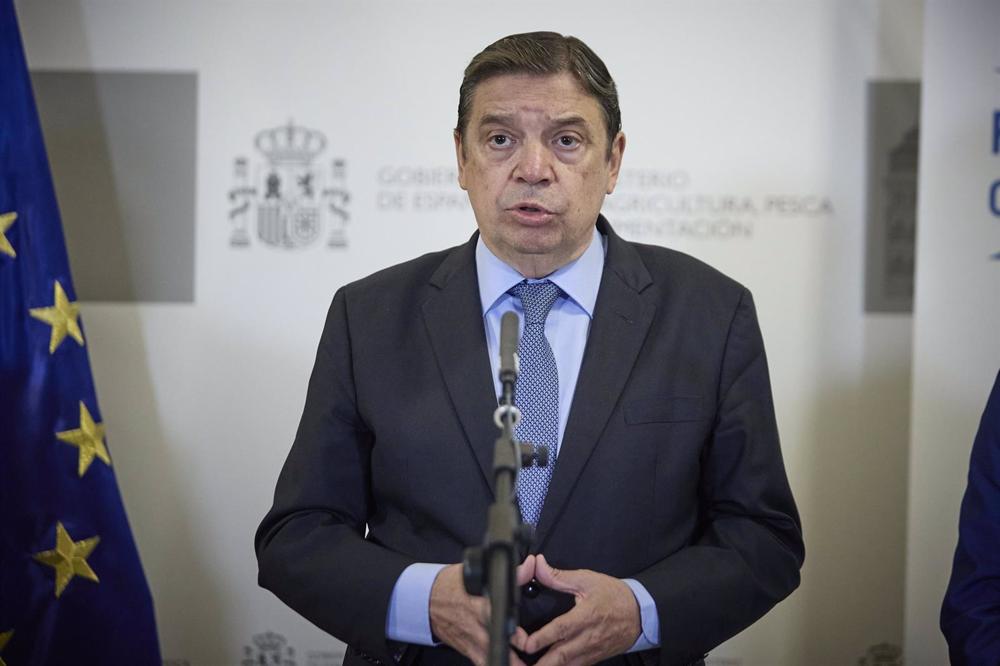
The Minister of Agriculture, Fisheries and Food, Luis Planas, has called for greater involvement of the European Commission to ensure the supply of fertilizers in the European Union (EU) because «there can be little talk of food autonomy» without a «fundamental» element such as fertilizers, which he considers, together with seeds, as the «chips» of agriculture.
Planas has moved this Monday to Brussels to participate in the meeting of the Ministers of Agriculture and Fisheries of the EU, where Spain will ask, supported by 15 other Member States, that the Commission «concrete measures» and offer solutions «in the short term».
This is the Spanish government’s response to a European Commission document that proposes the use in 2023 of a reserve of 450 million euros for the whole of the EU with an increase in the ceilings of state aid but, according to Planas, «it is not an eternal solution».
«The Commission should seek support mechanisms beyond the reserve, which also involves a detraction of payments from the Common Agricultural Policy (CAP), to use it for other measures,» explained the minister, who advocates «opening new paths on the road to autonomy and food sovereignty in fertilizer.»
«Let’s be clear: we can hardly talk about food autonomy without a fundamental element such as fertilizers, which are, together with seeds, the chips of agriculture», he stressed.
As the Minister explained, the European Commission has made an X-ray of the situation as a consequence of the increase in gas prices, which has slowed down the production of nitrogen fertilizers at the peak, from 70% to 50%.
Phosphate fertilizers have also experienced a rise in prices, which is, as Planas has warned, a «real problem» from the point of view of supply for farmers and with «serious consequences» also on the final price of food itself for consumers.
Therefore, the minister has called to seek support mechanisms, which are «absolutely necessary» to resolve the doubts of farmers in relation to planting, whose performance depends on soil quality, in which plays a «fundamental» fertilization.
Another of Spain’s proposals for this Agricultural Council is to explore new ways of fertilization, such as the use of manure and slurry, as well as improving advice to farmers in this area.
On the other hand, he pointed out that Spain is «satisfied» that it has been possible to «redirect» the Black Sea Agreement on the exit of cereals and oilseeds because it seems «necessary» for the supply of world markets. An agreement from which Spain has also benefited by acquiring two tons of these crops of the total of 10 that has been released.