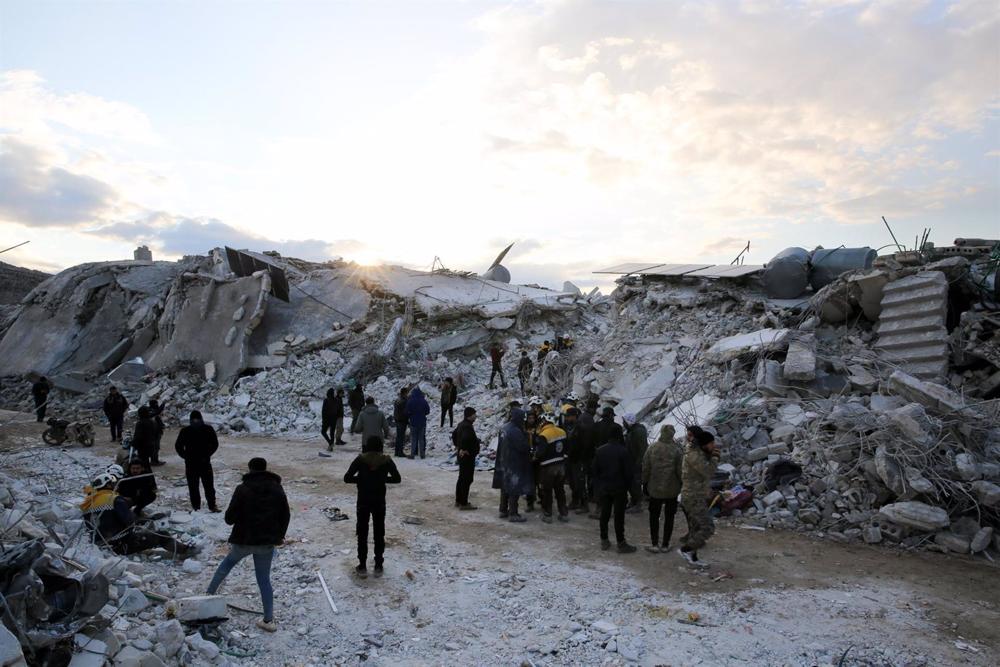
The first United Nations convoy with humanitarian aid crossed the border between Turkey and Syria on Thursday to deliver aid in the northwest of the Arab country to those affected by the earthquakes registered on Monday, which have left more than 17,000 dead, including more than 3,000 in Syrian territory.
The head of the mission of the United Nations Office for the Coordination of Humanitarian Affairs (OCHA) in Turkey, Sanjana Quazi, said in statements to the Qatari television channel Al Jazeera that «UN cross-border aid operations have been restored today» with the passage of six trucks through the Bab al Hawa crossing, the only one authorized for this type of operation.
«We are relieved to be able to reach the people of northwest Syria at this pressing time. We hope this operation will continue as it is a humanitarian lifeline and the only channel that can be expanded,» he said, after the delivery of humanitarian aid in northwest Syria was suspended following the devastating earthquakes, which damaged the road connecting Gaziantep to the UN transit hub in Hatay.
For its part, the International Organization for Migration (IOM) has indicated that the humanitarian convoy is carrying sheets, blankets, tents and shelter material, as well as essential supplies and light bulbs to cover the needs of at least 5,000 people.
«This is a catastrophe for the region and our hearts go out to all those affected who have lost loved ones, homes and livelihoods. We are working closely with the authorities to support in every way possible and we hope that aid will reach those most affected quickly,» said the agency’s director general, António Vitorino.
OCHA said Wednesday it had identified two alternative routes to reach its transit hub from Gaziantep via Kilis and Kirijan and from Mersin via Adana and Kirijan. Asaad al Achi, head of the civilian organization Baytna Syria, confirmed that Turkey has authorized the delivery of aid through two additional crossings – Bab al Salama and Al Rai.
The UN humanitarian coordinator for the Syrian crisis, Muhannad Hadi, noted on Wednesday that «there is a glimmer of hope of being able to reach people» and advanced that deliveries could restart this Thursday. In 2022, about 600 truckloads of humanitarian aid crossed Bab al Hawa to deliver aid to 2.6 million people each month.
The situation in northwest Syria remains complicated due to the extensive destruction and the fact that only five percent of the sites affected by the earthquakes are being covered by emergency teams, led by the Syrian Civil Defense, known as ‘white helmets’, which also lack heavy machinery for debris removal.
LACK OF CRANES AND HEAVY EQUIPMENT In this regard, the ‘number two’ of the ‘white helmets’. Munir Mustafa, has lamented in declarations granted to the German news agency DPA that «they lack the essentials». «We need big cranes to remove big pieces (of debris). We need heavy equipment to deal with this tragedy,» he explained.
Ubada Zekra, who is coordinating the rescue operations of the ‘white helmets’, has indicated that the agency’s workers are using shovels or their own hands to remove debris. «Some of us have not slept more than six hours for the last 60 hours,» he said.
Zekra stressed that some volunteers are refusing to rest because they are trying to save as many lives as possible and added that «emotionally, it has been hard for most of us.» «We are mainly looking for our relatives and sometimes our own families,» he said.
A resident of the city of Jindires, one of the most affected by the earthquakes, has criticized that «the world has left them aside, as usual.» «We have lost everything,» said this man, who still has 20 members of his family buried under the rubble. «The first day we heard their voices under the rubble, but little by little they died out. The situation is desperate,» he said.
Nearly 12 years of war have left 15.3 million Syrians in need of humanitarian aid. Basic services in northwestern Syria have been destroyed by the war in this part of the country, where 4.1 million people, including millions of internally displaced persons, are dependent on international aid.
The ‘White Helmets’ have indicated that more than 1,900 people have been killed and 2,950 injured in rebel-held areas in the provinces of Idlib and Aleppo (northwest), a figure to which must be added 1,262 dead and 2,285 wounded in the areas of the Arab country controlled by the authorities. Turkey has also confirmed the death of more than 14,000 people on Turkish territory, according to the latest balance sheet provided by its president, Recep Tayyip Erdogan.
Source: (EUROPA PRESS)