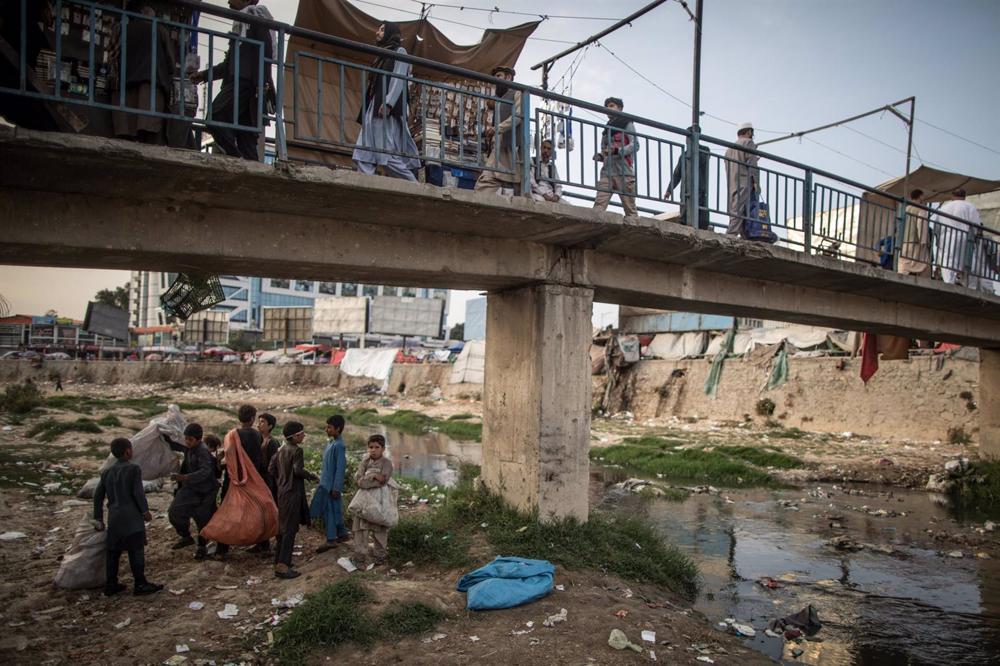
The International Committee of the Red Cross (ICRC) has warned of an «accelerated» increase in cases of pneumonia and child malnutrition in Afghanistan due to the economic crisis, which puts the population in a situation of having to choose between «eating or heating», a situation of particular concern due to the onset of winter.
The ICRC has noted that 33 Afghan hospitals supported by the agency have seen a 90 percent increase in child malnutrition cases in 2022 over 2021 data, from 33,000 to 63,000 so far this year.
Specifically, the number of under-fives being treated for pneumonia at a children’s hospital in the capital, Kabul, has increased by 55 percent in 2022 compared to the same period last year.
«The level of poverty in Afghanistan has increased compared to the last few years. Most people are unable to buy materials to heat their homes and protect their children from the cold,» explained Abdulqayum Azimi, an ICRC doctor who coordinates the organization’s program at the Indira Ghandi Hospital in Kabul. «They are also unable to buy adequate food for the children, so cases of pneumonia are on the rise, and those of pneumonia-associated malnutrition will also increase,» he said.
In this regard, the ICRC has indicated that the situation «remains alarming,» despite the fact that the intensity of fighting has decreased «significantly» following the Taliban’s seizure of the capital in August 2021, marking their return to power 20 years after the U.S.-led invasion.
The agency has explained that 24 million people, more than half the population, are in need of humanitarian assistance, while 20 million, half of Afghans, are acutely food insecure, a situation deepened by international sanctions and the impact of the war in Ukraine on the global economy.
The conflict has caused a spike in wheat prices, cooking oil and fertilizer prices have increased, while many people have lost their sources of income and depleted their financial reserves. The agricultural sector has also suffered the effects of earthquakes, droughts and floods, according to the ICRC.
«Afghan families face an impossible choice: to feed themselves or to have heating. The reality is that they can afford neither, resulting in a worrying increase in cases of malnutrition and pneumonia,» said Martin Schuepp, the ICRC’s director of operational activities.
«Humanitarian organizations cannot respond to all the overwhelming requests for help. We therefore urge states and development agencies to return to Afghanistan and continue to support the millions of people in need here,» he said.
Along these lines, Hayi Uali, the father of an eight-month-old baby sick with pneumonia, explains that, should he be discharged and they are able to take him home, «he will get sick again because it is not possible to pay the cost of heating for proper food.» «I already lost one of my children to pneumonia. But who should I call for help?» she laments.
For her part, Mahjabin, a mother of five children, notes «a worsening» of living conditions in the country. «Today we have no sources of income, no money to take my children to the clinic when they get sick. Winter is almost here, and I have nothing to make a fire to protect my children from the cold. It makes me very sad to see them in this situation where they don’t even have clothes,» she says.
Abbas, a wood seller, elaborates on the impact of the crisis on people’s lives: «There are no buyers. Nobody has any money. You can’t even get a job to afford a meal. There is no choice but to let the children suffer from the cold in winter or burn garbage to stay alive».
Schuepp emphasized that «every day lives are saved thanks to the dedicated and courageous work of men and women health workers, but the international community must redouble its support, as humanitarian organizations cannot be an efficient and long-term replacement for a functioning public sector».