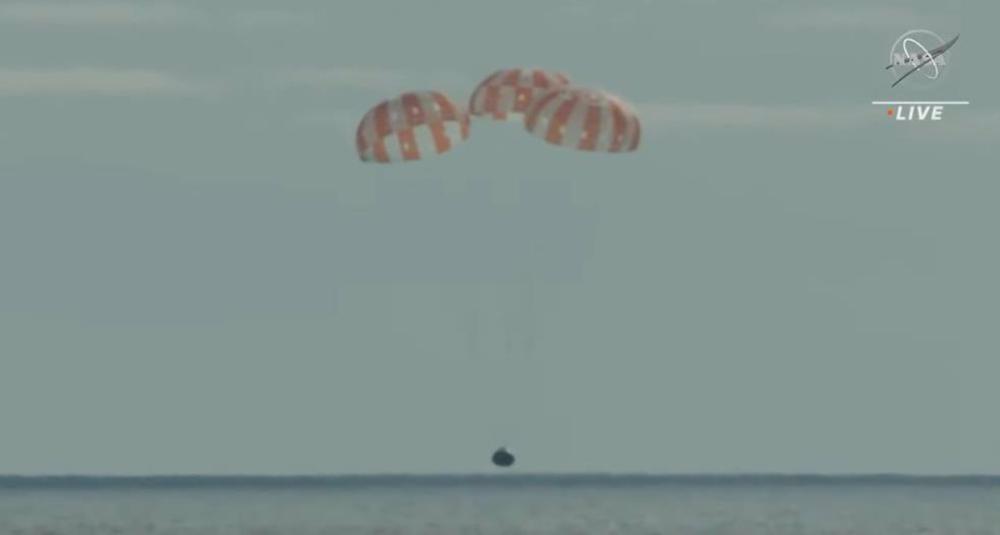
NASA’s Orion spacecraft of the ‘Artemis I’ mission returned to Earth this Sunday after a 25-day mission to lunar orbit, with a scheduled splashdown at 17.40 UTC in the Pacific Ocean near Guadalupe Island off the coast of Baja California.
The success of the mission credits the first step in a safe human transportation system between the Earth and the Moon.
Just before re-entry into the atmosphere, at 17.00 UTC, the manned module and the service module separated and only the manned module — in this first flight without astronauts — returned to Earth, while the service module disintegrated in the Earth’s atmosphere.
Applying a new technique, the crew module plunged into Earth’s upper atmosphere and used that atmosphere, along with the capsule’s ascent, to exit the atmosphere again, then re-enter for the final parachute descent and splashdown. This technique will allow safe re-entry for future Artemis missions, regardless of when and where they return from the Moon, NASA reports.
Orion entered our planet’s atmosphere traveling at 40,000 kilometers per hour and temperatures of approximately 2,760 degrees Celsius, which it endured thanks to the largest heat shield ever built. The atmosphere initially slowed the spacecraft to 523 km/h and then the parachutes reduced the speed as the spacecraft descended through the Earth’s atmosphere.
Parachute deployment began at an altitude of about 8 kilometers, with three small parachutes stripping the spacecraft’s front decks. Once the spacecraft’s forward decks were separated, two floating parachutes slowed and stabilized the crew module for deployment of the main parachute.
At an altitude of less than 3,000 meters with a spacecraft speed of 210 km/h, three pilot parachutes raised and deployed the main parachutes. These 35-meter diameter nylon fabric parachutes slowed the Orion crew module to a splashdown speed of only about 30 km/h (19 mph).
The parachute system includes 11 parachutes made of 11,000 square meters of material. The canopy is attached to the top of the spacecraft with more than 20 kilometers of Kevlar lines that are deployed in series using gun-like mortars and pyrotechnic thrusters and bolt cutters.
Once in the water the rescue teams proceeded to retrieve the capsule and all possible hardware discarded during the landing, including the spacecraft’s front deck and three main parachutes.
‘Artemis I’ is the first integrated flight test of NASA’s Space Launch System (SLS) rocket, an uncrewed Orion spacecraft and ground systems at the agency’s Kennedy Space Center. The mission will pave the way for a manned test flight and future human lunar exploration as part of the Artemis program.
During this 25-day flight, the Orion spacecraft flew farther than any spacecraft built for humans has ever flown, more than 450,000 kilometers from Earth, thousands of kilometers beyond the Moon, and stayed in space longer than any astronaut craft without docking with a space station, returning to Earth faster and enduring higher temperatures than ever before.
Orion flew just over 100 kilometers above the Moon’s surface at the beginning of its mission, then used the Moon’s gravitational pull to propel itself into a new deep retrograde, or opposite, orbit about 70,000 kilometers from the Moon. The spacecraft remained in that orbit for approximately six days to collect data and allow mission controllers to evaluate the spacecraft’s performance.
For its return trip to Earth, Orion performed another close flyby of the Moon and used another ESA-provided precision-synchronized engine firing of the service module, along with the Moon’s gravity, to accelerate back toward Earth.