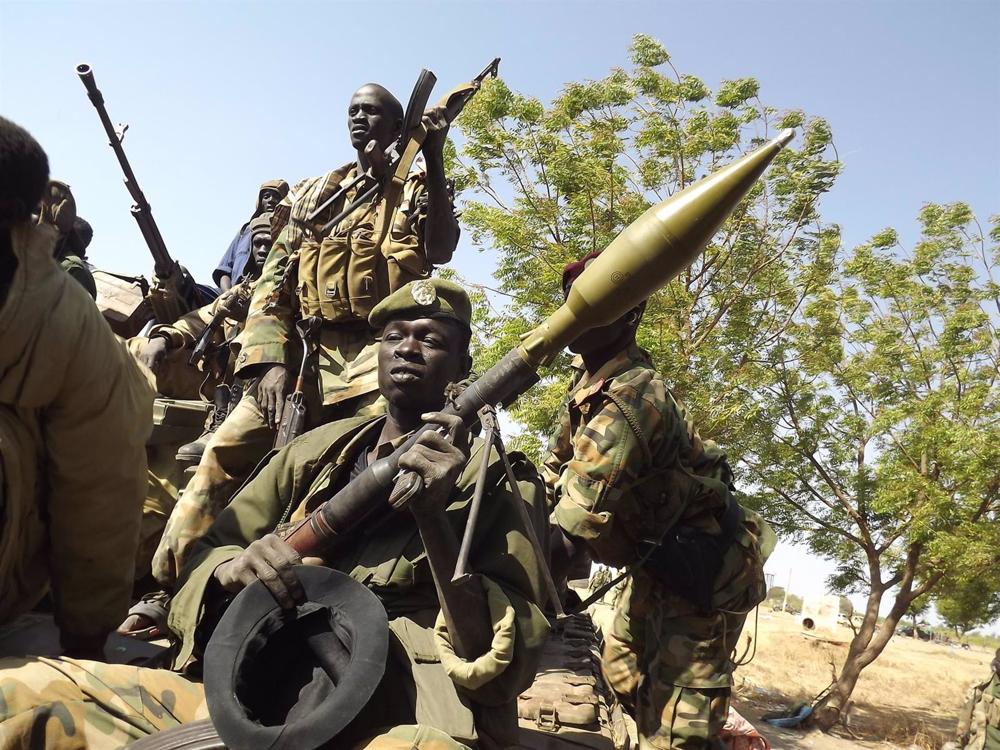
The South Sudanese Army has confirmed fighting between the military and «heavily armed» militiamen in the Pibor Administrative Area (east), amid an upsurge in inter-communal clashes in this area of the African country.
South Sudanese Army spokesman Lul Ruai Koang said that White Army militias supported by the South Sudanese Armed Forces have launched offensives in the area in the face of the latest incidents. «Army forces are still in active fighting in Kongor locality in Lokuangole,» he said, before indicating that pro-government forces withdrew on December 27 from the Gumuruk area, as reported by Eye Radio.
He stressed that the attacks against these localities «are a clear act of rebellion that must be confronted», after the Minister of Information of Pibor, Abraham Kelang Jiji, denounced the death of more than 55 people in inter-communal clashes.
Kelanj Jiji detailed that at least 56 people had been killed and 17 wounded, who have been transferred to medical centers in the locality of Gumuruk. The local authorities have reported that the attackers came from areas of the adjacent state of Jonglei.
As a result, Jonglei authorities have called on the central government to intervene and put an end to the fighting, while demanding the withdrawal of the assailants. Jonglei’s Information Minister, John Samuel Manyoun, has called them «criminals».
«If they are from Jonglei, the Jonglei government is asking them to return to the places they left,» he said, before denouncing «a cycle of violence that has existed for many years.» «We want support from the national government and our partners to solve this cycle of violence,» he reiterated.
The United Nations last week expressed its «deep concern» over calls for the mobilization of members of the Nuer community in Greater Jonglei and warned that it could lead to «massive attacks» against the population in this area of South Sudan.
The United Nations Assistance Mission in South Sudan (UNMISS) said in a statement that «these mobilizations have the potential to trigger violent attacks that severely impact civil society» and said that «any upsurge in conflict would undermine the progress towards peace achieved by contacts between leaders of Jonglei State and the Greater Pibor Administrative Area (GPAA).»
South Sudan has a unity government that was launched following the materialization of the 2018 peace agreement between President Salva Kiir and rebel leader Riek Machar, which resulted in the latter returning to the post of first vice president of the African country.
Despite the decrease in violence due to the political conflict, the country has recorded an increase in inter-communal clashes, mainly motivated by cattle rustling and disputes between pastoralists and farmers in the most fertile areas of the country, especially due to the increase in desertification and the displacement of populations.
Source: (EUROPA PRESS)