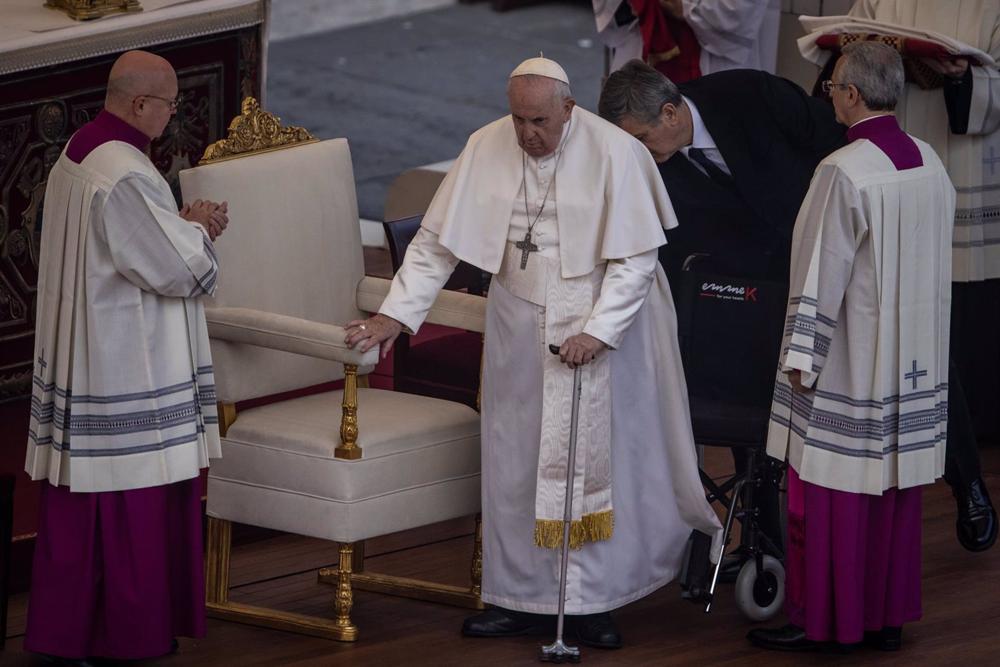
The Pope has warned of the danger of replacing personal interviews with machine learning algorithms (‘machine learning’) in asylum applications submitted by migrants and urged that «ethical reflection» be part of «the development of technical solutions.»
«You can take the example of asylum applications: it is not acceptable that the decision on the life and destiny of a human being is entrusted to an algorithm,» said the Pontiff in the speech he delivered when receiving on Tuesday, January 10, the participants of the symposium organized by the Vatican ‘Appeal of Rome for the ethics of Artificial Intelligence’, which concluded with the signing by leaders of three monotheistic religions of a document for the development of Artificial Intelligence governed by ethics.
Francis recalled that every person should be able to enjoy human development and solidarity, and that, therefore, we must «be vigilant» so that «the discriminatory use of these instruments does not take root at the expense of the most fragile and at the expense of the excluded». Thus, he asked that ethics «be increasingly present not only in the public debate, but also in the development of technical solutions».
«I am happy to know — said the Pontiff in his speech — that you also want to involve the other great religions of the world and men and women of good will so that algorethics, that is, ethical reflection on the use of algorithms, may be ever more present not only in public debate, but also in the development of technical solutions.»
The Holy See has long been working to raise awareness of the challenges posed by Artificial Intelligence. In April 2020 it set up the ‘RenAIssance Foundation’, an entity under the Pontifical Academy for Life to work in this field.
At Tuesday’s event, Father Paolo Benanti, professor of Ethics of Technologies at the Pontifical Gregorian University and scientific director of RenAIssance, gave an exhaustive presentation on the evolution of technology in the history of humanity and reflected on how urgent it is that the present and future technological development of the aforementioned algorithmic.
The symposium was also attended by the former Minister of Foreign Affairs, Ana Palacio, as well as the President of Microsoft, Brad Smith, the worldwide Vice-President of IBM, Dario Gil, the Chief Economist of FAO, Maximo Torero Cullen, among others.
At the end of the meeting, the President of the Vatican’s Pontifical Academy for Life, Archbishop Vincenzo Paglia, Chief Rabbi Eliezer Simha Weisz, member of the Council of the Chief Rabbinate of Israel, and Sheikh Abdallah bin Bayyah, President of the Abu Dhabi Peace Forum and of the Emirates Council for Sharia Fatwa, signed a document to develop an Artificial Intelligence governed by ethics.
The declaration calls for a framework «to regulate and reference a digital ethic,» an ethic that should promote the use of technology «for the benefit of humanity and the environment.» The document – which was drawn up two years ago by the Pontifical Academy for Life – specifies six basic principles that should govern Artificial Intelligence based on ethical criteria.
Source: (EUROPA PRESS)