The electoral race in Brazil has turned into a ‘holy war’ for the evangelist vote, with religion at the center of a political debate that is at the same time whipped by a hurricane of misinformation.
The president, the far-right Jair Bolsonaro, and the leftist former president Luiz Inácio Lula da Silva face each other this Sunday at the polls with the leadership of the South American giant at stake. Lula leads the polls of voting intentions with around 4.6 points of average advantage over the current leader of Brazil, who has closed the gap in recent days.
In that context of equality the evangelical vote will be key for a Bolsonaro who already managed to be elected in 2018 with the support of 70 percent of voters who profess that faith, by aligning his discourse with that of some of the most conservative and influential pastors of the Brazilian religious scene, who have claimed on numerous occasions the vote for the ultra-right leader, expressly or tacitly, despite the fact that the electoral law prohibits making electoral propaganda in churches.
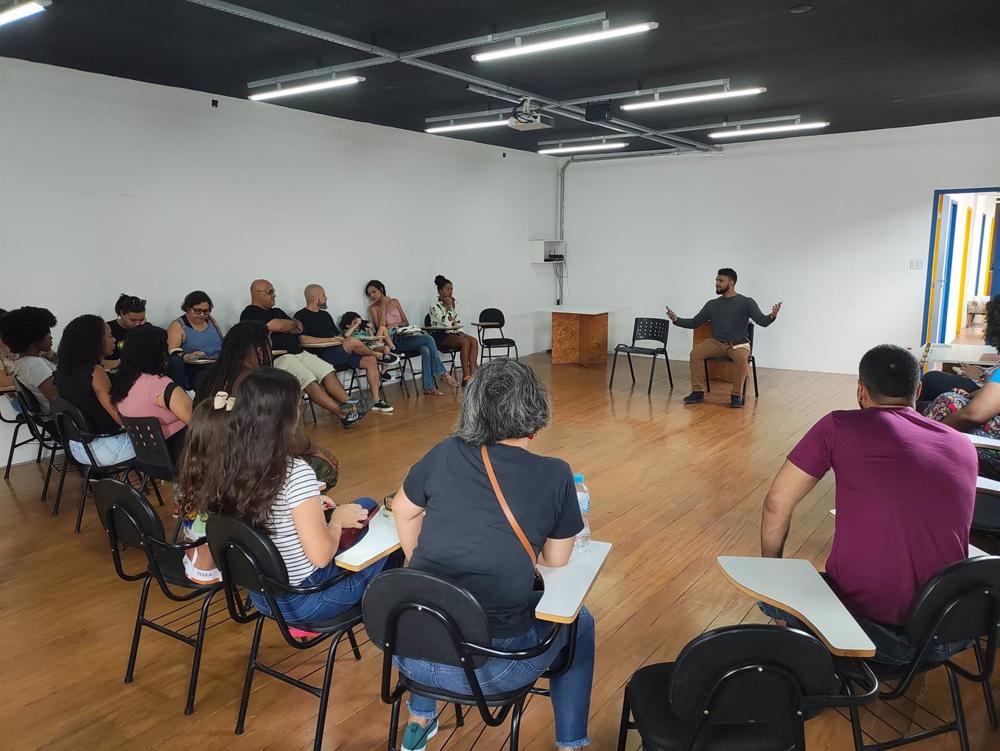
«The Church in Brazil is a gigantic project of power in its great majority, and politics is perceived as the best way to reach that power», comments Léo Matrapilho, after participating in an evangelical cult that defends the freedom to vote, plurality and diversity within the churches.
His congregation, Redençao Baixada, meets every Sunday in a coworking space in Nilópolis, a humble municipality in the northwest of Rio de Janeiro, with uncovered streets, two or three-story buildings whose facades are buried in electricity cables, with large pockets of poverty and where the ultra-right leader won in the first round.
Matrapilho, an Afro-Brazilian, with dreadlocked hair and whose body is tattooed with several biblical motifs, believes that Bolsonaro’s victory in his locality has a lot to do with the preaching in the evangelical churches.
«Today there are well-known evangelical leaders who are within that power project and Bolsonaro is the golden calf that is going to take them to that place of ascension and wealth, distant from the message of Jesus, which is for the poor and in pursuit of welcoming those who are affected by society,» adds the also member of the group known as New Evangelical Narratives.
CHANGE OF STRATEGY Around 32 percent of the voters declare themselves evangelicals and Bolsonaro dominates the majority of those suffrages. The latest survey by the Datafolha firm, published on October 20, gave the ultra-right-wing leader 66 percent of voting intentions in this segment, compared to 28 percent for Lula.
The former leftist president is aware of this disadvantage and has carried out several strategies in the second round to try to reduce the gap. A few days ago he sent a letter to the evangelical faithful in which he pledged to defend freedom of worship and the family, which he defined as «sacred».
He also said on television that he personally is against abortion, although he defends freedom of choice in this regard, and has been seen in religious environments.
A strong endorsement in that sense was the support given to him by Marina Silva, his former environment minister, a faithful evangelist, who had separated from the progressive leader a decade ago. Even so, he has not obtained the support of large churches, although he is defended by smaller congregations and leaders.
Bolsonaro, for his part, has remained faithful to his slogans «God, Homeland, Family and Freedom», as well as «Brazil above all, God above all», being accompanied by influential pastors such as Silas Malafaia, who even traveled with him to London for the funeral of Queen Elizabeth II.
The president’s discourse is clear: integral defense of the traditional family, opposition to abortion, to the legalization of drugs and to the introduction of the so-called ‘gender ideology’ in schools. To secure the evangelist vote, he has put his third wife, Michelle, who is a symbol interpreter in neo-Pentecostal cults, on the campaign trail.
FAKE NEWS Both candidates are also facing waves of ‘fake news’ with religious undertones. Lula’s campaign had to deny that the candidate is a satanist for having participated in the past in religious celebrations of Afro-descendant creeds. Bolsonaro was also accused of Satanism for having attended Masonic meetings.
Lula also denied that he was thinking of closing churches or establishing unisex bathrooms in schools, a concern in evangelical WhatsApp chats, while the current president was accused of cannibalism.
However, the identification of a significant part of evangelical leaders and cults with Bolsonaro and the ultraconservative vision has provoked dissent. In Redençao Baixada there are people who have left their churches due to the radicalization of the message, also political.
«We are a group that left a traditional church. We were no longer fitting that profile. The pastor and other members had influences like Silas Malafaia, who talk a lot of absurd things. The discourse began to become more extreme with speeches such as the military having to take action to solve Brazil’s problems,» says Maecio Gomes, another of the cult’s followers in Nilópolis, gathered around school tables in the coworking room.
«We are an isolated church, discriminated against and marginalized. Bolsonaro won here in the northern zone of Rio de Janeiro because he has co-opted the discourse in the churches and in the second round he will win again,» he adds, near a window through which dozens of cables that fill the streets of the humble municipality in the metropolitan area of Rio appear.
«Those who think like us are demonized,» Matrapilho adds. «They tell us that we are not real Christians, that we don’t follow Jesus, that we are abortionists and want to legalize drugs. That is violent, because being Christians is what gives meaning to our lives and attacks our sense of belonging to a greater thing which is the gospel of Jesus.»
He also believes that the reasons for evangelical support for Bolsonaro go beyond the political. «The church has been instrumentalized politically for its own benefit, such as the tax exemption that there was for many of them.»
Forty-nine percent of Brazilians say that the religion of the candidates is very important when deciding how to vote in a country that will go to the polls on Sunday in an atmosphere of great polarization.