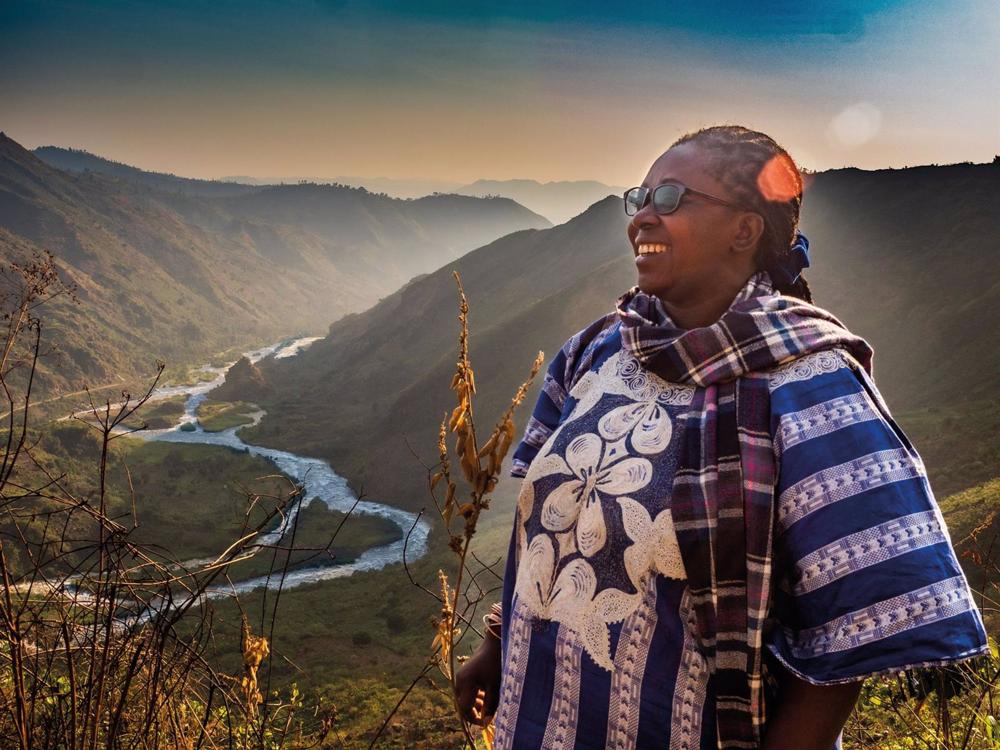
The activist and lawyer Yvette Mushigo has regretted that the Congolese population has «stopped trusting» the United Nations Mission in the Democratic Republic of Congo (MONUSCO) because its deployment «has not yielded fruits of peace» and has lambasted the inaction of the ‘blue helmets’, who «see people dying and do nothing».
«People are asking MONUSCO to leave because they have the impression that they are of no use to us. The population is attacked near MONUSCO barracks and MONUSCO does not intervene. They tell us that it is because of their mandate, but nobody understands that,» he explained, before asking how it is possible that «a mission like this has been in the country for more than twenty years and has not been able to put an end to the violence».
This is what he said during an interview with Europa Press at the headquarters of the magazine ‘Mundo Negro’, in Madrid, where he clarified that although it is true that on occasions the mission «has helped the DRC Army to train itself», the Congolese «have stopped trusting» in its work.
In this sense, he reported that demonstrations are taking place in the vicinity of the barracks and criticized the words of the UN Secretary General, António Guterres, who warned that the M23 rebels «are even more armed than the Congolese Army and MONUSCO». «Their presence is no longer understandable,» he added.
Mushigo, who received the Black World Award for Fraternity 2022 and coordinates the network of organizations Synergie des Femmes pour la Paix et la Réconciliation (SPR), which brings together more than 40 associations for the defense of human rights in the DRC, Burundi and Rwanda, pointed out that the Congolese are «tired of the cycles of violence».
This is why he stressed the importance of international aid to the countries of the region being «conditioned by demands regarding the establishment of peace» in the area. «Any development project that is carried out must be conditioned by the idea of truly seeking peace. There have been many peace agreements, but when it comes to putting them into practice this leads to problems. Sometimes the sovereignty of the States is not even respected,» he said.
Regarding the sending of aid to the region, he recalled that recently the European Union has provided an aid package to Rwanda «just when the country is collaborating in attacks against the DRC». «This causes a lot of skepticism among the population. Aid must be subject to a series of conditions», he said before affirming that it is necessary to «demand results».
In relation to the conflict in eastern DRC, a country where 70 percent of the population lives below the poverty line despite being one of the richest on the African continent in mineral resources, he stressed that it is an «economic war related to the extraction of minerals and other products».
«These minerals are exported illegally and enter the international market, why not demand more transparency on the provenance of these minerals? A country that does not produce them how is it possible for it to be the largest exporter in the world?» he has exposed in relation to Rwanda’s role. «We must demand greater transparency because that would facilitate the end of the conflict,» he continued.
However, he stressed that Rwanda «is not an enemy» for the Congolese and called for «distinguishing between political and social issues in order to live in cohesion». While admitting that at the political level «it is a problem that has implications for coexistence», he warned of the prevalence of a «political manipulation, which has nothing to do with the reality» on the ground.
WOMEN’S HUMAN RIGHTS In the DRC, violence against women has been instrumentalized. According to data from Doctors Without Borders, in the east of the country, 75 percent of women between the ages of 15 and 49 have reported having suffered physical or sexual violence by their partner. For Mushigo, this makes it vitally important to «teach women about their rights», which becomes «a threat to those who oppress them».
«Women are considered fragile beings who have to be protected. This also constitutes a fragility for men within a patriarchal system. In our context, the man has to protect the woman, it is a reaffirmation of his masculinity that he is able to protect her,» he stressed.
In this context, he emphasized that «when a woman is attacked or raped, the man feels touched, humiliated», while if a woman is forced to move, this fragility extends «to the whole community».
That is why she has vindicated the need for women to «know their rights» despite the fact that this can be seen «as a provocation» for those who oppress them. «The knowledge of rights gives women power and dilutes the power of those who exercise violence against them, it is a threat to those who want them to be dependent. When women discover their rights this balance is broken and there are people who feel threatened,» she reaffirmed.
On the laws in force in DRC, she has stated that the Family Code was reformed in 2015 precisely so that the woman does not have to ask permission to sign work contracts or move as long as her husband does it. «Now there is talk of a greater interest of the household,» she has pointed out.
In this sense, she has recalled that there is a law that requires that 50 percent of positions in public institutions be held by women, something that «has never come to be fulfilled». «There are difficulties in putting these laws into practice,» she said.
CYCLICAL VIOLENCE Mushigo spoke, in turn, of the «eternal recommencement» that the African country is experiencing in terms of abuses and violence. «Every day we hear that there have been new attacks and new displaced people (…) People are starting to get tired of reliving things that have already happened in the past. All this has consequences and there are fewer and fewer humanitarian organizations working in the area,» he warned.
He stressed that the number of displaced people «continues to increase» and regretted the consequences. «Before there were more humanitarian organizations, but now they have closed their offices and have left. This is not encouraging. It is a serious problem for all the people who are already living in very difficult conditions and who now seem to have less support than before,» he stressed.
In relation to this, he has emphasized that the media have given a vision of the eastern DRC as «a dangerous zone, a red zone in which it is difficult to work». «They forget that in these areas there are people who need help, who are doing a job», denounced Mushigo, who insisted that much of the information disseminated «is not based on the reality on the ground».
«It is important that the information be truthful because there is a lot of misinformation (…) There is no clear strategy to intervene in a fair way because there is no coherence between the information that is available and the reality», he concluded.
Source: (EUROPA PRESS)