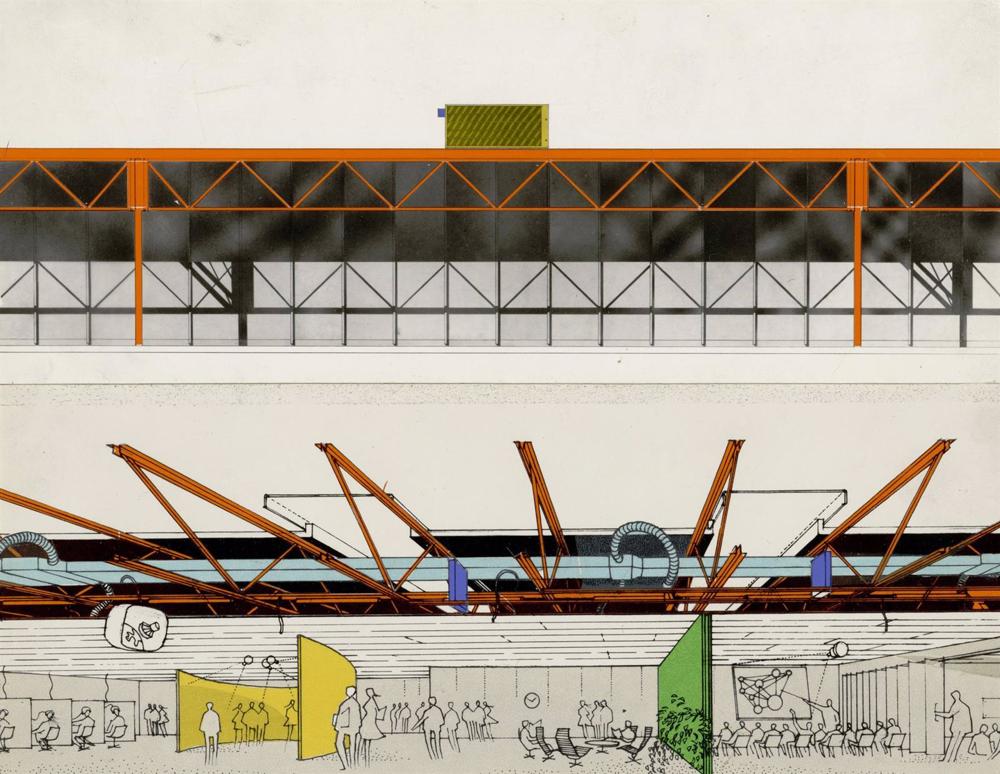
The largest retrospective of the last six decades of Norman Foster’s work will open on 10 May at the Pompidou Centre in Paris, according to the institution.
With a surface area of almost 2,200 square metres, the exhibition will review the different periods of the architect’s work, highlighting projects such as the headquarters of the Hongkong and Shanghai Banking Corporation (Hong Kong, 1979-1986), Carré d’Art (Nîmes, 1984-1993), Hong Kong International Airport (1992-1998) and Apple Park (Cupertino, United States, 2009-2017).
«This exhibition focuses on sustainability and anticipation of the future. The birth of the studio in the 1960s coincided with the first signs of awareness about caring for the planet. These were the first shoots of what would later be called the ‘Green Movement’. These principles may be mainstream now, but more than half a century ago they were revolutionary and anticipated today’s reality», explained architect Norman Foster.
The exhibition traces the architect’s work through seven themes: ‘Nature and Urbanity’; ‘Skin and Bones’; ‘Vertical City’; ‘History and Tradition’; ‘Planning and Place’; ‘Networks and Mobility’ and ‘Future’. Drawings, sketches, original models, dioramas and videos will allow visitors to see up to 130 of the architect’s projects.
At the entrance to the exhibition, a drawing gallery displays pieces such as drawings, sketchbooks, sketches and photographs taken by the architect. The exhibition includes works by Fernand Léger, Constantin Brancusi, Umberto Boccioni and Ai Weiwei, along with industrial creations, such as a glider and several classic automobiles, which have often served as a source of inspiration in Foster’s works.
A 264-page catalogue accompanies the exhibition, presenting his work through eighty of his most recognisable projects. This monograph includes three folders showing the early sources of inspiration for the projects carried out in collaboration with Richard Buckminster Fuller, as well as other drawings and sketches. The volume is published by Éditions du Centre Pompidou and edited by Frédéric Migayrou, curator of the exhibition.
Source: (EUROPA PRESS)