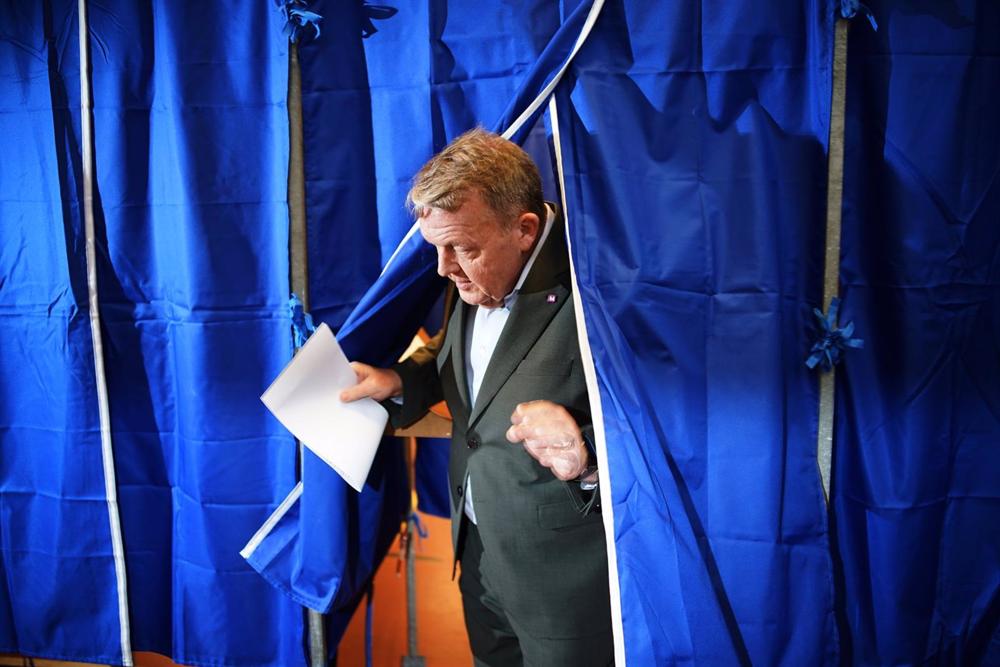
Former Prime Minister Lokke Rasmussen, who may hold the key to governability in Denmark’s next new government, has expressed his satisfaction with the first projections following exit polls, which do not show majorities.
The projected results of the general elections called early rule out majorities in the conservative and left-wing blocs, so that the current Social Democratic Prime Minister, Mette Frederiksen, can only secure a new four-year term through Rasmussen, who has not said who he will support.
«If the forecasts hold with approximation, then this small new party in the Folketing will come in a way in which the difference will be felt,» Rasmussen has said, as reported by the daily ‘Jyllands Posten’.
Exit polls published by DR and TV2 broadcasters have given the so-called «red» bloc, composed of the main political formations that made up the previous Executive, between 85 and 86 seats, close to the absolute majority set at 90 parliamentarians.
On the other hand, the ‘blue bloc’ would be between 72 and 73 seats, weighed down by the fall of the Danish People’s Party. Previous polls showed that the Danish People’s Party would fall by around six percent, while Venstre would also suffer a setback, falling from 21.1 percent in the previous elections to around 12 percent of the vote.
If these projections are confirmed, the result could make Rasmussen, a former center-right prime minister defeated by Frederiksen in 2019, the key to forming a government, with 17 MPs projected for his new centrist party, the Moderates, holding the balance of power.
The general election is being held early after the Social Liberal Party–the Social Democrats’ governing partner–forced the prime minister to bring forward the vote in exchange for not tabling a no-confidence motion.
The economic management of the country at a convulsive moment for the whole of the old continent due to the war in Ukraine, added to a report against the management of the Executive of the mink crisis, slaughtered by a mutation of the coronavirus, were the main arguments for the pressures of the government partners.
Thus, Frederiksen finally agreed in early October to call general elections for this Tuesday, eight months before the technical expiration of the current legislature in which, after the 2019 elections, the Social Democrats reached the government with the support not only of the Social Liberal Party, but also of the Green Left and the leftist Red-Green Alliance.