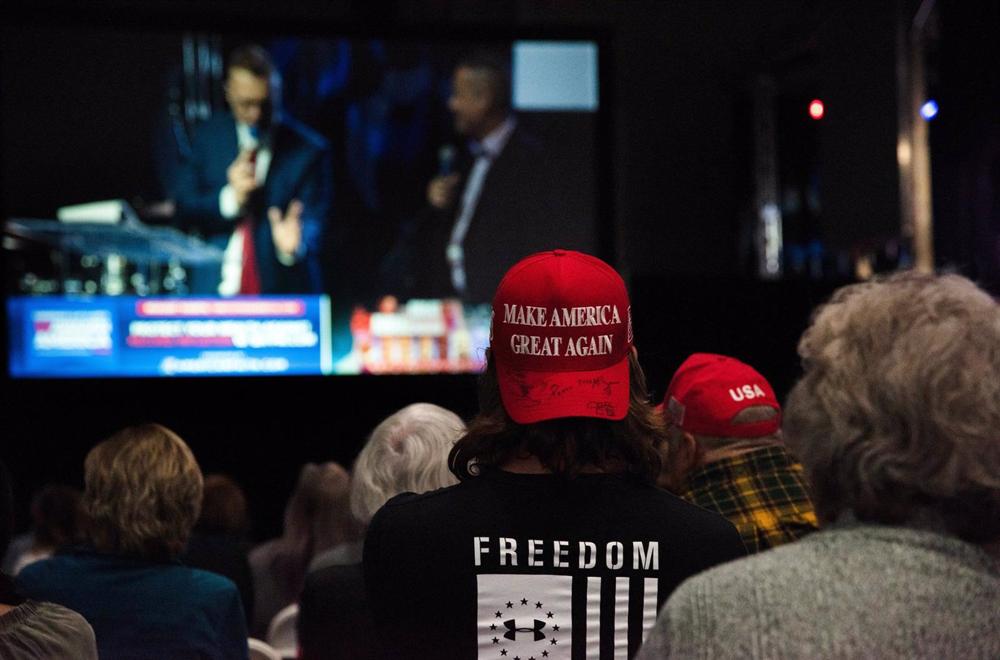
Donald Trump’s time in the White House marked a turning point in the trust that citizens have in their institutions and, in particular, in the electoral system. The former president questioned the transparency of the elections in which he was defeated, with conspiracy theories that continue to make a dent in the face of the imminent legislative elections.
In the 2020 election process, Trump questioned basic pillars of the system such as the absentee ballot and, after the victory of his rival, Democrat Joe Biden, he continued to question the transparency of the same framework that four years earlier had allowed him to sit in the Oval Office. He encouraged from his loudspeaker on social networks all kinds of theories and mobilizations such as those that would trigger on January 6, 2021 in the assault on the Capitol.
Two years later, the polls continue to reflect the anti-system messages. A poll published in July by Gallup placed small businesses, the Armed Forces and the Police among the most trusted institutions and Congress at the bottom of the list: only 12 percent trust this bicameral body at least ‘quite a lot’.
This survey reflected an average level of trust in all institutions unprecedented in more than four decades — just 27 percent — with particularly low rates for Republicans. Only 5 percent of Trump’s party supporters believe in the work of Congress and 2 percent in that of the current president.
Republican suspicion is also evident in another Pew Research Center poll, conducted ahead of the November 8 legislative elections, where the two major parties will vie for control of the House of Representatives and the Senate. Currently, both chambers are under Democratic control.
Seven in ten Americans have confidence in the organization of the current process, but the figure drops to 56 percent if only potential Republican voters are taken into account. Among Democrats, 88 percent believe that the process will go fairly or very well, assuming that there will be no problems that would call into question its outcome.
There is a more or less widespread level of confidence in in-person voting, 79 percent among Republicans and 95 percent among Democrats, but the numbers plummet for absentee voting, according to the poll, based on nearly 5,100 interviews. Only 37 percent of Republican Party supporters trust a method against which Trump already charged hard in the 2020 elections, wielding alleged failures that have never been proven.
VOTING TRUMP, DISTRUSTING THE SYSTEM In fact, the impact of the tycoon’s messages is noticeable among his faithful. If among Republicans who declare themselves neutral or distant to Trump there are 67 percent of people who take for granted the good management of the legislative elections, the figure already falls to 55 percent when examining the opinions of those who feel close to the former president and 49 percent in the case of those who declare themselves very close.
In addition, Republicans far from Trump are mostly confident in the postal vote (56 percent), but only 26 percent of those who have a greater affinity with the former president, who in recent months has even agitated the possibility of running again in the 2024 presidential elections, think so.