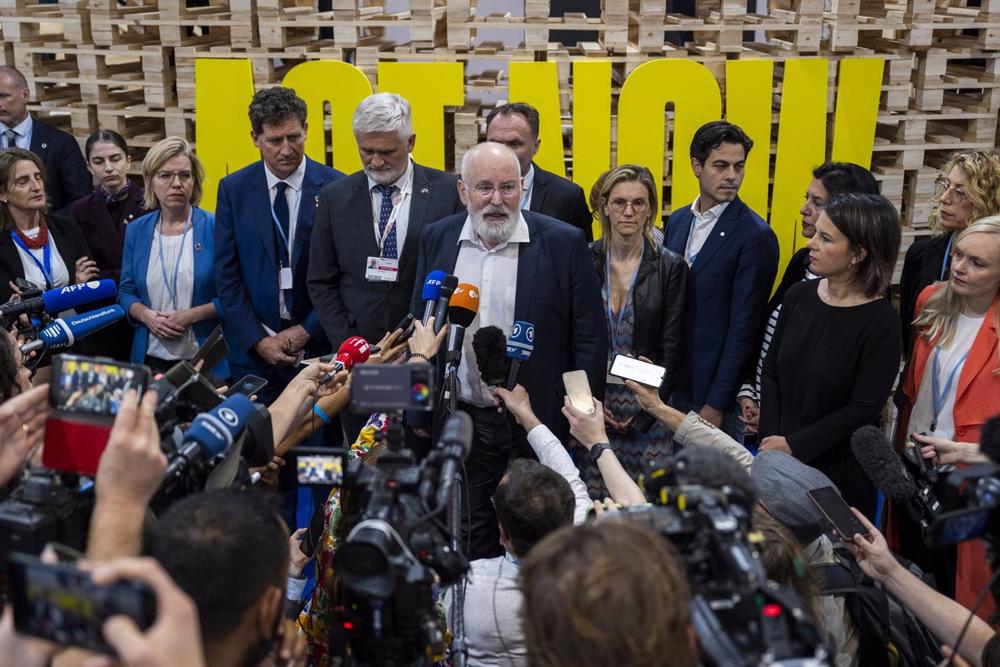
The Third Vice President for Ecological Transition and Demographic Challenge, Teresa Ribera, has confirmed that the XXVII Conference of the Parties to the Framework Convention on Climate Change being held in Sharm-El Sheikh, is going through a «very sensitive, very delicate and worrying» moment because «apparently» what is being proposed by the Egyptian Presidency of the COP27 is a reduction and slowing down of the fight against climate change in which «Europe cannot be an accomplice».
Speaking to the media on this first day of extension of the Summit being held on the shores of the Red Sea, Ribera has charged against the Egyptian Presidency of the COP because «there has never been a situation like this». «We have never encountered a Presidency that was advocating a containment of progress in the fight against climate change,» he criticized.
However, he pointed out that the texts proposed by the Presidency, which «are not appropriate» and are not those that have been negotiated and that during the night Egypt has been «showing them on screen» so that the parties have not been able to analyze them in detail, have yet to be confirmed. Therefore, he hopes that it will be possible that when «finally» the texts are made public, they will not be those «first flashes» that have been shared throughout the early hours of Saturday morning.
Ribera estimates that it will be next night when an agreement is reached but warns that this will depend on the specific texts and reactions in a plenary during the afternoon or «how much is biased» the president of the COP «in one direction» that can generate a «great difficulty» to achieve consensus.
In any case, he wishes for a «reasonable margin of doubt» although he recalled that this is not the first time that the Climate Summits have gone through «historically very delicate» moments, first in 2000 in Holland and in 2009 in Copenhagen.
«Honestly, it is very worrying. I believe that Europe cannot be complicit in a reduction, a slowdown in the fight against climate change, which is what they are apparently proposing to us,» he insisted.
Very critical of the role of the COP Presidency, Ribera noted that Egypt has preferred to make its «own reading» and share it as if it were the basis for a final result and considers it «very important» to respect that «all» countries can contribute and that the result is «balanced».* We are at a moment of maximum tension», acknowledged the Vice-President, who added that the Presidency’s proposals are beginning to emerge «for the first time» and that they will have to be studied «in detail» and, therefore, she hopes to be «in time to reach an agreement» * In any case, she assured that for the EU it is «fundamental» that the objective of containing emissions so that the temperature does not rise more than 1.5ºC is an attainable objective, which requires «increasing ambition».
HARD TO UNDERSTAND A RETREAT In his opinion it is «very difficult to understand» that at COP27 the results are below those of the 2021 conference in Glasgow and of a trajectory of many years in which the idea that «everyone» has to contribute, whether from the public or private sector, has been reinforced. «At the moment that is what is at stake,» he said.
Ribera argues that the first measure of solidarity with the most vulnerable should be to «preserve» that the risk does not exceed 1.5ºC in the world and that the planet does not reach 2.8ºC of increase as «everything indicates that it may be real» at the end of the century at this time if sufficient resources are not found to mitigate the damage of climate change.* For this reason, he reiterated that for the EU the agreement must start from the «very important» premise that it must be «coherent» with the objectives of the Paris Agreement and that it must continue to build the «multilateral» reality so that the fight against climate change is «effective».
THE EU IS NOT COMPLICIPAL In short, he stressed that the EU should not be «complicit» in a final decision in which it is accepted to reduce ambition or that countries with large emissions do not have to contribute. «I think this is clearly understood. It seems to me that we should not support a decision of this nature,» Ribera said, who has shown the EU’s willingness to contribute financially but does not want to accept the proposals of «some» who want «precisely to be shielded so as not to have to increase their ambition».
Regarding the two critical moments, he recalled that in the year 2000, with the Netherlands in the Presidency, the complication to make the Kyoto Protocol agreement viable was «so great» that the president of the Conference suspended the negotiations and called for a second part six months later, when the agreement was finally reached.* The second «milestone» considered as «a notorious and well-known failure» that complicated further progress in the fight against climate change was the 2009 meeting in Copenhagen, when the aim was to update the picture of where climate efforts should come from, which could no longer correspond only to the rich countries of 1992, but the large emerging countries with high emissions should also contribute.
Ribera recalls that «extraordinarily complex» negotiation, which ended in a huge disagreement that could not be resolved until a year later at the Mexico Summit.
If there is a failure in Egypt, it will be because «it is not possible to accept proposals that shield some countries from having to contribute at the speed and with the transparency required in this process of transforming the financial system, which would increase solidarity contributions and accelerate the pace of decarbonization.