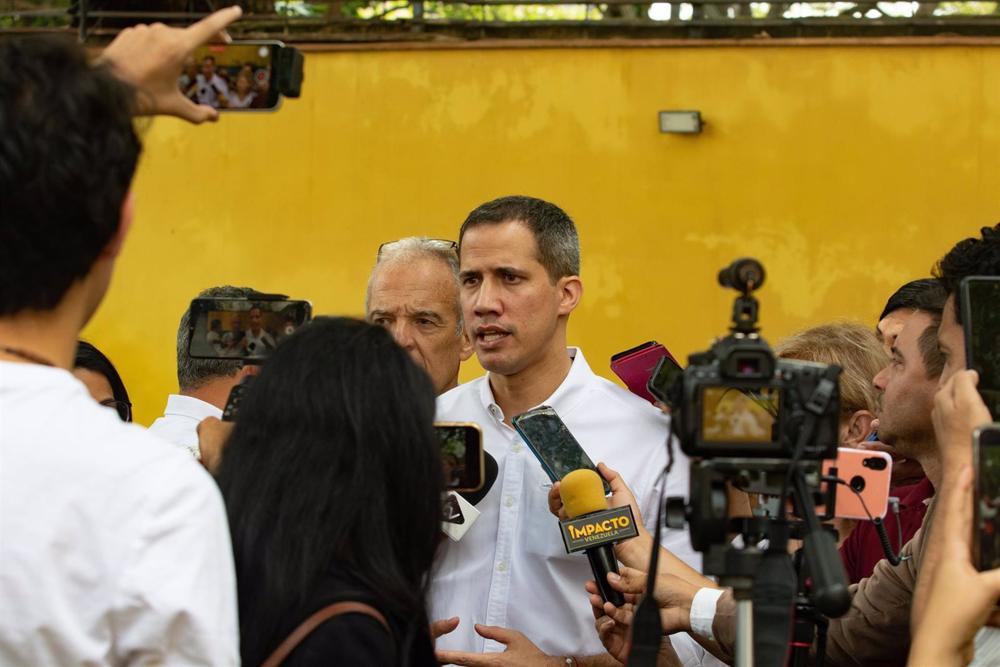
Venezuelan opposition leader Juan Guaidó, deposed this month as leader of the National Assembly alternative to chavismo, has warned the Spanish government that this is not the time to «relativize» the «dictator» Nicolás Maduro, who maintains his «systematic scheme of persecution» over dissidence.
Guaidó proclaimed himself almost four years ago ‘president in charge’ of Venezuela, asserting his headship of the Assembly that had been elected at the end of 2015. More than half a hundred countries endorsed this move, but international backing has faded in recent months.
Already as a deputy, after the change of the leadership in the opposition Parliament, Guaidó has warned against any «rapprochement» with Maduro, just as governments considered democratic would not reconsider approaching now the president of Russia, Vladimir Putin.
«It benefits neither democracy nor the rights of citizens,» said Guaidó, who in a telematic interview to Europa Press has avoided directly criticizing the decision of the Spanish government to raise again to the first level, that of ambassadors, the degree of diplomatic relations between Madrid and Caracas.
On the reasons, «we would have to ask President (Pedro) Sánchez», said the opposition leader, who nevertheless recalled that «relativizing the actions of the regime does not help the political prisoners who are still behind bars» in the South American country.
Appointing an ambassador «is not to make a dictator responsible», added Guaidó, who acknowledged that he has not been in contact with the new diplomatic representative, Ramón Santos Martínez.
Thus, he has pointed out that any rapprochement must be accompanied by «progress» in terms of democracy and respect for human rights. «For Spain and for the rest of the democratic world, the demand has to be that fair and free elections are held», he added.
He also called on the Spanish authorities to disregard the request for arrest made this week by the Chavista Prosecutor’s Office against members of the new leadership of the opposition Assembly, among them the president, Dinorah Figuera, who resides in Valencia.
For Guaidó, it is «clear» that «it is a political action, not a judicial one». «Our expectation is that it is recognized as such» and that, therefore, Spain leaves «without effect» any such request arrived from the South American country.
NEW OPPOSITION CHIEF Guaidó has questioned the move of his fellow opponents to put an end to the political cabinet he led, a «political» decision that he considers «absolutely ill-advised» and even «unconstitutional». He trusts «not to lose sight» of the fact that the enemy is still Chavismo.
This crisis has evidenced the fractures in the opposition, something that Guaidó himself has acknowledged benefits Maduro. «If Maduro’s dictatorship has invested in something, it is in making it look like there are oppositions», he has affirmed.
The solution, in his opinion, is to «rebuild the alternative», for which he marks as a first milestone the call for primaries to elect a common candidate for the future presidential elections, in an attempt to reedit the successes achieved during the period of Henrique Capriles.
On his potential candidacy to this process, Guaidó avoids pronouncing himself. «We do not rule it out», he has limited himself to say, waiting however to make a final decision when there is a clear timetable on this process still up in the air.
Guaidó has said he maintains «regular contact» with his party colleague Leopoldo López — «as with many other political leaders» — who lives in «unjust exile» in Spain. Questioned about the possibility of a candidacy of López, Guaidó has pointed out that the objective of the primaries is «that all those who want to participate can do so».
One of the first decisions of the new Assembly has been to abolish most of the delegations that Guaidó’s cabinet had abroad. For the opposition leader, this is a «setback» on several fronts: «We should be growing in diplomatic offensive, nor decreasing».
«Having a constant and stable presence in democratic countries is a window to make the crisis visible, to seek help,» he added, in a new defense of «tools» such as sanctions to try to achieve some kind of change in Venezuela.
Maduro has tried to play the energy card to claim a withdrawal of these punishments. Guaidó has recognized that «energy always plays a fundamental role in the geopolitical sphere», but to those who see Venezuela as a possible source of supplies he has reminded them that «Maduro cannot even help himself» because «there is «no gasoline» in Venezuela».
«Venezuela is a country with oil, but it is not an oil country. For that we would need billionaire investments», he has argued. For Venezuela to be «reliable» in energy matters, «we need democracy», Guaidó has reiterated.
In recent months, Maduro has tried to recover his lost presence in international forums, as was evident in the recent UN summit on climate change held in Sharm el Sheikh (Egypt). Then, he exchanged public greetings with leaders such as France’s Emmanuel Macron.
«Maduro was begging for recognition and some world leaders were helping him», said Guaidó, before warning that whoever approaches the Venezuelan leader «overshadows his image».
DIALOGUE WITH THE GOVERNMENT The opposition and the government keep open a dialogue that for now has not resulted in major advances and about which Guaidó has been cautious. «The possibility of an agreement», he has indicated, «has always been just that, a possibility».
It depends in his opinion on «multiple factors», but he has put the ball in the court of Chavism, since he considers that «it depends exclusively on the dictatorship to be able to move forward». However, «we understand that the political solution involves an agreement», he pointed out.
One of the great opposition demands is to claim the elections that «must» the chavismo, for which there is still no date –theoretically they are scheduled for 2024–. Guaidó sees Maduro as «the easiest candidate to defeat» in that appointment, since he considers that «popularly» he is the one who has less citizen support.
Source: (EUROPA PRESS)