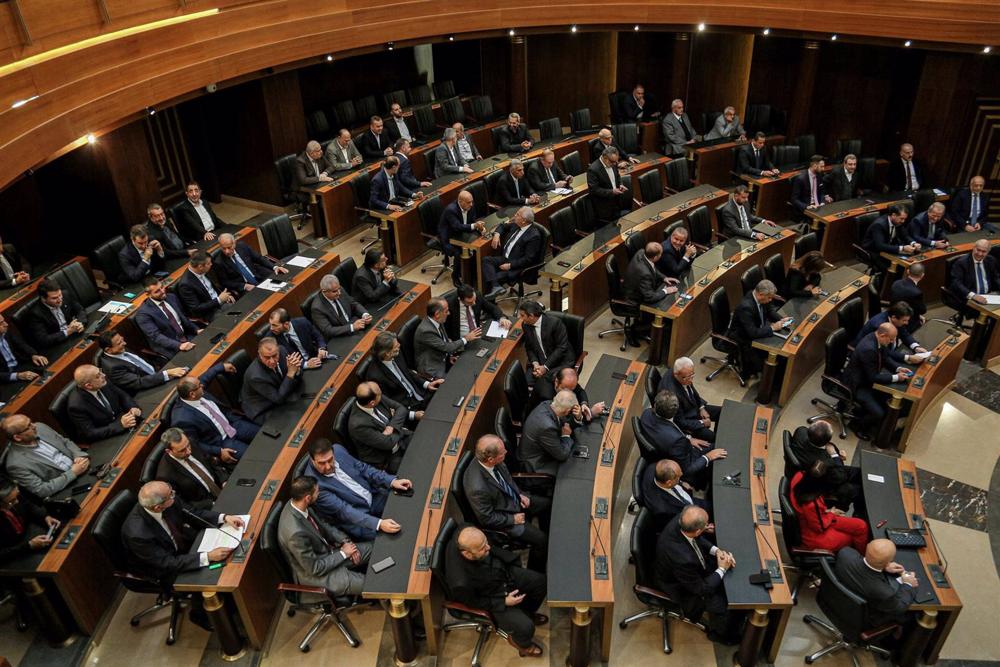
Two Lebanese parliamentarians have launched a sit-in at the legislative body to protest the lack of agreement on the appointment of a new president, after Michel Aoun’s term expired on October 31, amid a serious political crisis in the country.
«Faced with the harsh conditions in which we live and the absence of justice and the most basic rights, we insist on the need to elect a president,» said MP Nayat Aoun Saliba through a message on her account on the social network Twitter.
«To this end, we have started a sit-in inside the Parliament to raise our voice on the need for a president capable of putting an end to the collapse of the country,» she said, before calling on parliamentarians to agree on electing a president.
Also taking part in the sit-in was parliamentarian Melhem Jalaf, according to local media. Both spent the night from Thursday to Friday inside the Parliament and have not yet announced whether they will remain there indefinitely until the election of a president.
Jalaf himself had stressed on Wednesday that «the election of a president who can save Lebanon is urgent» and announced that he will present an initiative to keep the Parliament in continuous session until this goal is achieved.
The protest was launched after Parliament failed on Thursday in its eleventh attempt to elect Aoun’s replacement, at a time when the government is also in office after having resigned, plunging the country into almost total political paralysis.
Thursday’s vote resulted in 34 votes in favor of reformist MP Michel Muauad, 37 blank ballots and fourteen with the text ‘New Lebanon’. The parliamentarians of the Shiite party-militia Hezbollah and its ally, the also Shiite AMAL, withdrew from the chamber after the first round — in which they voted blank –, causing a loss of the quorum.
For his part, the leader of Hezbollah, Hassan Nasrallah, called on Thursday for the election of «a brave president willing to sacrifice himself» and who «does not care about the threats of the Americans», as reported by the Naharnet news portal. «We want a president to be elected, a government to be formed and the country to be saved. We want a president who will not flee from Baabda Palace to the Mediterranean Sea if the Americans attack him,» he said.
«There are examples of this and we must seek such a government and such ministers,» said Nasrallah, who further stressed that the Lebanese are capable of relaunching the country «if there is the will and the right plan» to do so, in the face of the deepening humanitarian crisis in Lebanon.
RISING FOOD INSECURITY In this context, around two million people residing in Lebanon, including 1.29 million Lebanese and 700,000 Syrian refugees, face food insecurity, according to the first Integrated Food Security Classification, released on Thursday.
The analysis predicts that the situation will deteriorate between January and April 2023, with 2.26 million people expected to be in a «crisis» phase or worse, requiring urgent assistance, the report said.
The study, conducted by 55 national experts during September, shows that Akkar district has the highest figures for food insecurity among Lebanese residents, followed by Baabda, Baalbek and Tripoli. Among Syrian refugees, the situation is worst in Zahle, followed by Baalbek and Akkar.
The results of the analysis were unveiled Thursday by Lebanon’s Agriculture Minister Abbas Haj Hassan, the UN Food and Agriculture Organization (FAO) representative in Lebanon, Nora Urabah Hadad, and the World Food Program (WFP) country director, Abdallah al-Uardat.
Food insecurity in Lebanon is being exacerbated by the economic crisis, including a sharp depreciation of the currency, the withdrawal of various subsidies and the rising cost of living, which is preventing many families from obtaining sufficient food and meeting their basic needs.
«More people than ever in Lebanon are dependent on aid,» said Al Uardat. «These findings are deeply troubling and reflect the harsh situation faced by many people in Lebanon,» he maintained.
In this regard, Hadad said the report «paints a stark picture of food security in the country, adding that they «reconfirm the urgent need to transform food and agriculture systems to make them more efficient, inclusive, resilient and sustainable.»
«This first study on Lebanon represents a unique opportunity to highlight the importance of joining our efforts as national and international communities to provide sustainable support to the people who need it most through combined humanitarian and development interventions, with an integrated approach,» he said.
Finally, Hassan stated that «the goal has always been to create a joint and realistic vision for Lebanese society at the economic and social level, linked to food security and to ensure that food security is not compromised, while guaranteeing the ability of Lebanese citizens to meet their daily needs».
Source: (EUROPA PRESS)