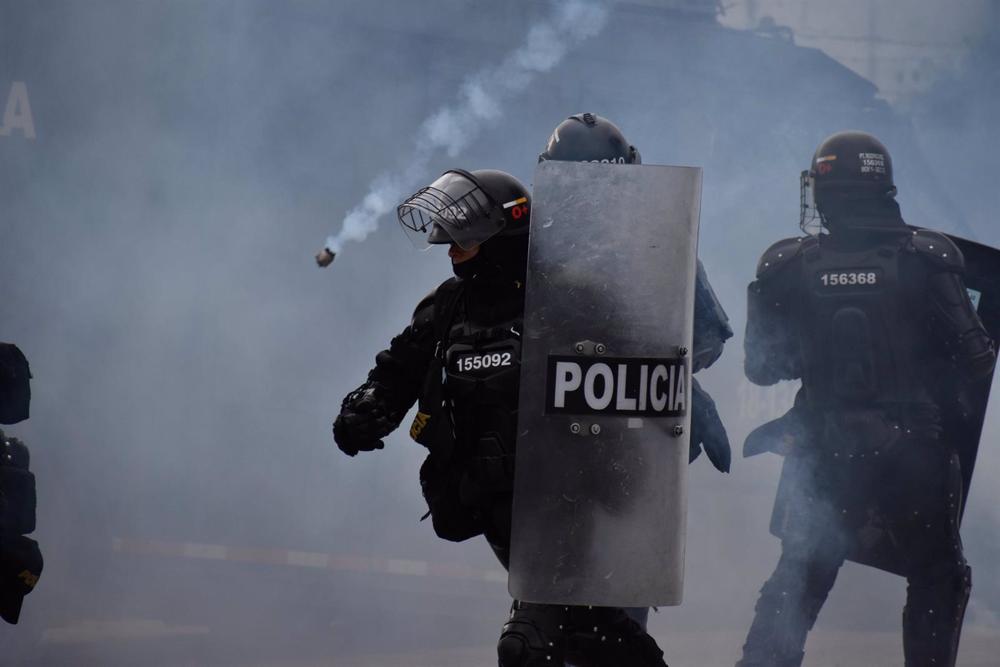
The Inter-American Commission on Human Rights (IACHR) has expressed its concern over impunity for violence by security forces in Colombia in the face of protests and the arbitrary detention of people who are then not granted provisional release. Colombian President Gustavo Petro has promised reparations for the victims.
The IACHR has presented a follow-up report on 28 of the 41 measures it recommended the Colombian authorities implement following its 2021 visit to Colombia during the serious unrest during the national strike against the government of then-President Iván Duque. Of these, three have advanced partial compliance; 14, partial compliance and 11 still have no level of compliance.
Thus, it recognizes progress in the reform of the Police and the transformation of the Mobile Anti-Riot Squad (ESMAD), but highlights that despite the declared intention of the Government, these bodies continue to depend in practice on the Ministry of Defense.
The IACHR also expresses its concern that investigations into police abuse remain in a state of considerable impunity despite the opening of numerous files.
«The vast majority of open cases continue in the preliminary stages of investigation of the facts. Likewise, the IACHR notes that the State has not adopted measures to provide and coordinate comprehensive and timely reparation programs for the victims under the terms of the recommendations,» the report states.
They also expressed their concern over information received on the «persistence» of situations of violence during the demonstrations following the 2021 strike.
Regarding the Citizen Security Law, the IACHR warns that it can be used to «repress acts of protest and discourage citizen participation through punitive power» so they requested to prevent the «arbitrary application» of this law.
The IACHR also highlights the lack of progress in the approval of a statutory law that regulates and sets limits to protest, as also ordered by the Colombian Supreme Court of Justice, and the recommendation of non-lethal weapons in the control of demonstrations.
The Pan American organization also asks to review the situation of the persons who were «arbitrarily detained» in the framework of the protests and to review the possibility of their conditional release during their judicial processes.
The text highlights that they have agreed with the new president, Gustavo Petro, to implement a follow-up and monitoring mechanism for compliance with these recommendations.
PETRO’S PROMISE President Petro has received at the Palacio de Nariño, the presidential palace, the president of the IACHR, Julissa Mantilla, and the commission’s rapporteur for Colombia, Joel Hernández, to discuss the IACHR’s recommendations.
«I have met with the Inter-American Commission on Human Rights to examine its recommendations on the 2020/21 social outbreak. The State is committed to repair the victims it left on the occasion of the repression it unleashed against the social movement,» Petro stated on his Twitter account at the end of the meeting.
Also participating in the meeting was the Deputy Foreign Minister for Multilateral Affairs, Laura Gil, who confirmed the agreement to create a mechanism to follow up on the recommendations «with the participation of civil society». «We believe they have the potential to produce structural changes that will allow us to guarantee non-repetition,» she said.
Mantilla stressed that the report «recognizes the concrete facts of the outbreak, but the structural causes and, above all, this follow-up of recommendations implies addressing the situation, guaranteeing the right to protest, respect for intersectionality, the rejection that must be given to the judicialization of protest».
Hernandez stressed the importance of the meeting «because it has shown the vocation of cooperation of President Petro with the Inter-American Commission on Human Rights and the Inter-American Human Rights System.» «The commission will accompany national efforts to guarantee the right to social protest. It has truly been a unique opportunity, rarely seen, of such a close level of cooperation,» he explained.
Source: (EUROPA PRESS)