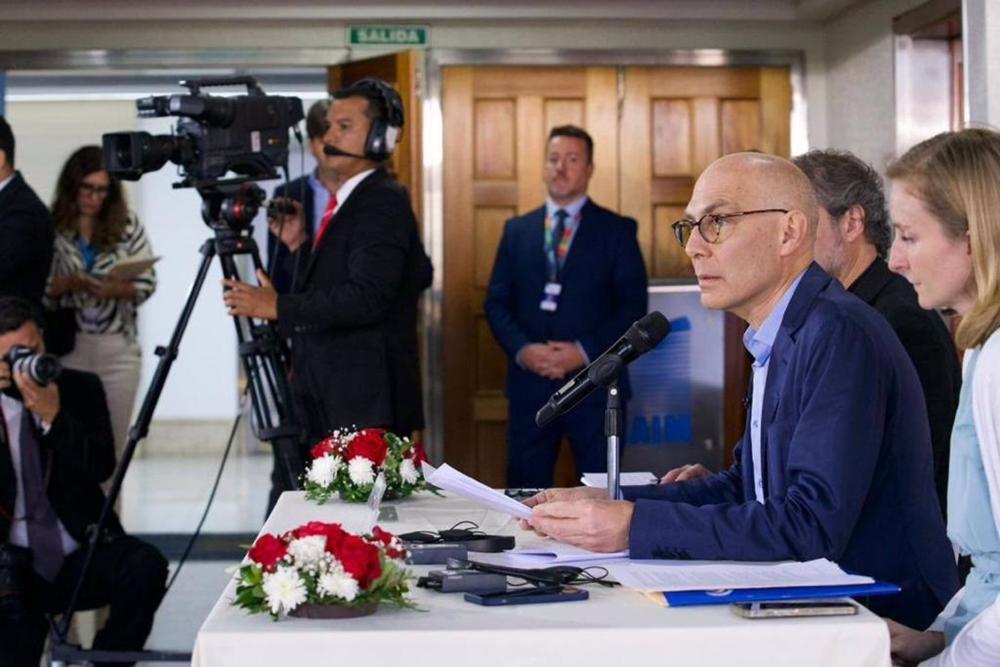
The Venezuelan government and the UN High Commissioner for Human Rights, Volker Türk, have agreed to extend for two years the special mission of the Office of the High Commissioner for the Caribbean country.
Türk himself announced the measure during an official visit to Caracas in which he was able to observe the «deep social divisions» and the «human rights challenges facing this country in the civil, political, economic and social spheres», explained Türk’s office in a press release.
Türk highlighted the intense agenda of meetings that allowed him to meet with high-ranking government officials, starting with President Nicolás Maduro, and with up to 125 members of civil society, human rights defenders, victims of human rights violations and representatives of victims’ organizations from all over the country.
In the meetings with the authorities, Türk addressed issues related to civic space, detention conditions and judicial delays, among others, and called on them to take «significant steps» to reform the justice and security sectors. «I perceive that there is a general recognition across the political and social spectrum of the need for reform,» he explained.
«I have heard stories of people arbitrarily detained and tortured, and of family members killed in security operations and demonstrations. One woman overcome with emotions as she recounted how two years earlier her sister had been detained, raped and tortured. In my meetings with the President and ministers, I asked for the release of all arbitrarily detained persons», she stressed.
Thus, Türk has raised the «extensive and prolonged use of pre-trial detention.» «I was promised that allegations of torture would be dealt with decisively, thoroughly investigated and those responsible would be brought to justice,» he has assured.
Civil society representatives have for their part shared information with Türk about the «often dire situation in prisons and the lack of food, adequate medicines and access to timely health care.» In this context, he has asked to extend his team’s visits to all prisons in the country, including those under military jurisdiction.
They have also conveyed to him «strongly» the economic problems facing Venezuela, «including those related to the minimum wage and pensions, and the impact this has on people’s daily lives by restricting the enjoyment of their rights to food, water, health care, education and other economic and social rights.»
«They described regular power cuts, lack of running water, quitting their jobs, unable to survive on their monthly pay,» he recalled, while mentioning UN reports that put the number of people in need of humanitarian aid in the country at seven million.
IMPACT OF SANCTIONS Türk also mentioned that different groups of people, including humanitarian actors and UN agencies, «told me about the impact of sectoral sanctions on the most vulnerable segments of the population and the obstacles that sanctions create for the recovery and development of the country, especially after the pandemic».
«While the roots of Venezuela’s economic crisis predate the imposition of economic sanctions, as I highlighted in my interactions, it is clear that the sectoral sanctions imposed since August 2017 have exacerbated the economic crisis and hindered the enjoyment of human rights,» he stressed.
For all these reasons, he has recalled that his Office has repeatedly recommended the suspension or lifting of measures that «have a detrimental effect on human rights and are aggravating the humanitarian situation, a call we also make with regard to unilateral coercive measures imposed on other countries.»
Finally, Türk mentioned the dialogue opened with the opposition in Mexico, reiterated his support and stressed «the need to listen to the victims in the political process.» «Just as a river keeps flowing despite the stones in its path, engagement and constructive dialogue can forge a way around obstacles,» he said.
Source: (EUROPA PRESS)