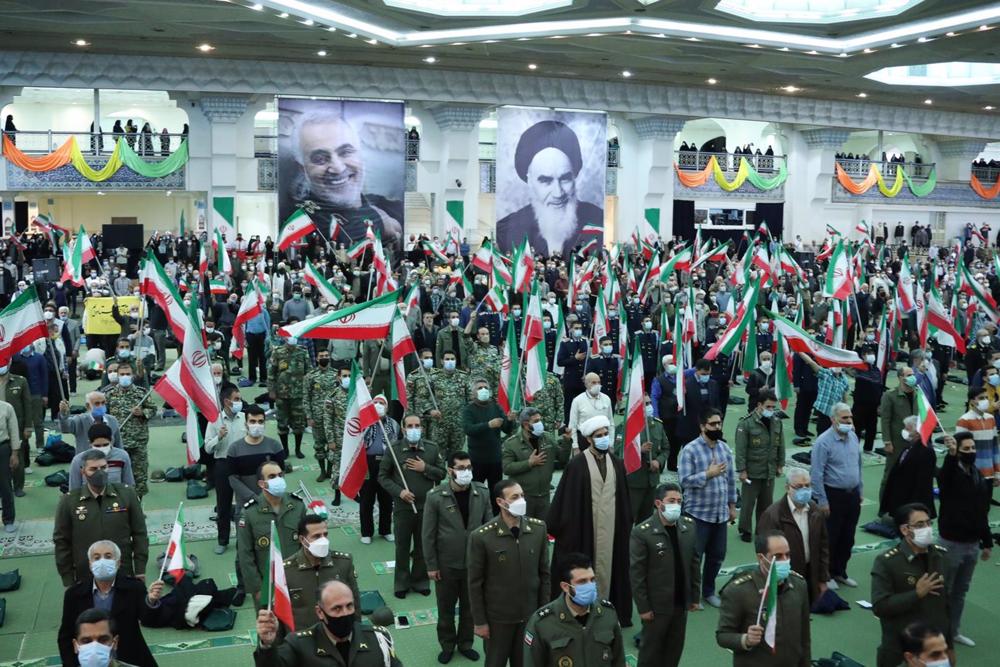
Hundreds of thousands of Iranians commemorated the 44th anniversary of the Islamic Revolution on Saturday beginning with a military parade in Tehran, flagged by the deployment of domestically manufactured ballistic missiles and drones.
The streets of the capital have become the stage for the Emad missile and the Shahed-136 tactical unmanned aircraft, the same model that, denounce Ukraine and its Western allies, is being used by Russia during the war.
The commemoration has spread to 3,400 cities and 3,800 towns across the country, amid huge tension over protests against the death last September of young Iranian Kurdish woman Mahsa Amini while in custody for allegedly wearing the Islamic veil incorrectly.
In this regard, and during the opening of the commemoration, Iran’s supreme leader, Ayatollah Khamenei, participated in a meeting with a group of commanders and officers of the Iranian Air Force and Air Defense, where he reiterated the existence of an «evil plot» against the country against which it is necessary to maintain «a strategy of unity», according to the semi-official ISNA news agency.
The Iranian authorities have blamed most of the disturbances on «rioters» in the pay of foreign powers, while NGOs estimate that between 400 and 500 demonstrators have died as a result of repression by the security forces. The government has tried to defuse the situation by declaring its usual amnesty for thousands of prisoners, including those arrested in connection with the demonstrations.
The Islamic Revolution, which put an end to the monarchy and raised Ayatollah Ruhollah Khomeini to power, was a political earthquake that reshaped the region and whose consequences are still in force at the political and social level today, marked by growing opposition to the authorities and the regional projection of Tehran, which has provoked the reaction of rivals in the area.
Khomeini’s return to the country took place at a time when the Pahlevi dynasty, one of the main allies of the United States in the region, was on the verge of collapse due to the economic and social crisis and the rise of opposition to the regime due to the repression of protests in previous years.
The final blow to the regime came on February 11, when the Supreme Military Council declared itself «neutral» following the outbreak of guerrilla clashes in the streets, ruling out the possibility of a military uprising in favor of the shah.
Source: (EUROPA PRESS)