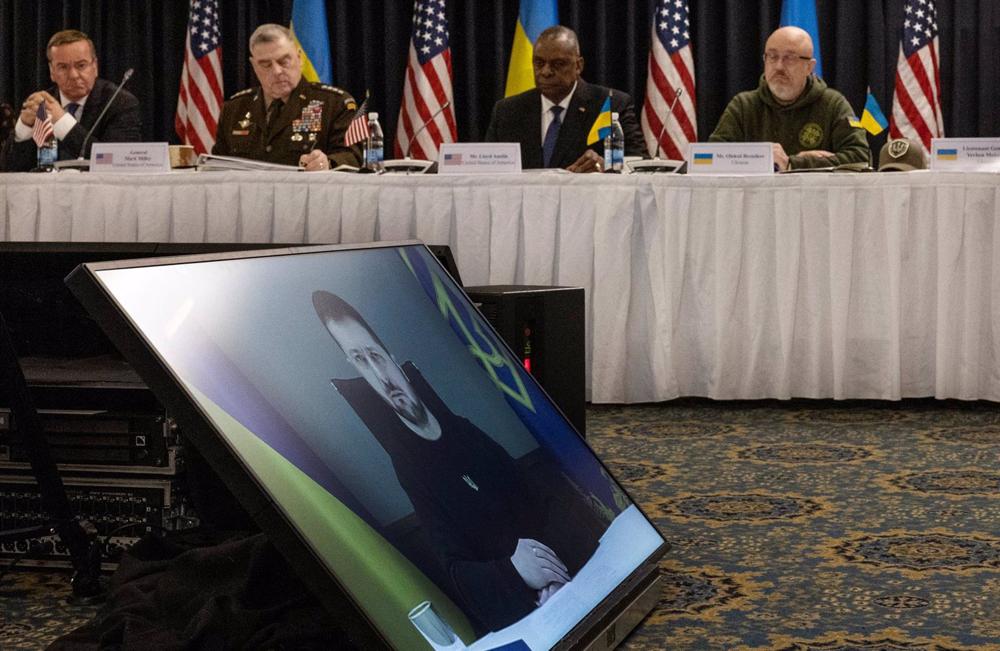
The Ramstein group, the military coalition of more than 40 countries supporting Ukraine under the leadership of the United States, will finalize this Tuesday at a meeting in Brussels the supply of Kiev’s battle tanks, in an appointment in which they will discuss how to reinforce the anti-aircraft aid to the Ukrainian Army but in which any announcement about the fighter jets demanded by the president, Volodimir Zelenski, is ruled out.
The meeting of the Contact Group for Ukraine on Tuesday, prior to the meeting of defense ministers, will be used to define the details with the Ukrainian Minister of Defense, Oleksi Reznikov, of the deployment of tanks promised by a number of countries at the end of January, a coalition of which Spain is a member, although its contribution is still pending confirmation while Defense is carrying out technical reviews of half a dozen tanks.
«My top priority is that the allies’ commitment to deliver armor, infantry vehicles and tanks is made as soon as possible because every day counts,» NATO Secretary General Jens Stoltenberg told a press conference ahead of the meeting of allied defense ministers.
In the case of Spain at the moment, the company Santa Bárbara is already working on the repair and rehabilitation of five Leopard 2A4 battle tanks, an information that the Minister of Defense, Margarita Robles, who will attend the meeting of the Ramstein format tomorrow, has advanced.
Other allies have detailed their support to Ukraine on the land front, as in the case of the United Kingdom which has 14 Challenger tanks, while Germany, Denmark and the Netherlands have confirmed at least 100 Leopard 1A5 tanks, an armament considered essential for Ukraine to repel Moscow’s offensive in the Donbas and to recover territory occupied by Russian troops.
The coalition could mobilize over a hundred Western tanks, to which would be added the contribution of tanks from Poland or the Baltics. «This will not change the rules of the game, but it helps to maintain the support dynamic. Ukraine needs weapons and more tanks will be needed, but the taboo has been broken,» explains another allied source on this step.
«We still have to bring positions closer on tanks, as some allies have not yet committed,» these sources have indicated.
Before the ministerial meeting that comes barely ten days before the first anniversary of the Russian invasion of Ukraine, Stoltenberg reiterated that the Russian aggression has demonstrated NATO’s relevance by showing «the importance of allies standing together», «both to provide support to Ukraine and to protect each other, ensuring that the war does not escalate beyond Ukraine».
The same message is stressed by allied sources who indicate that unity in NATO is «unshakable» in the face of the pulse raised by Moscow. «Some questioned whether the allies would maintain the level of support, I am impressed by the level of unity and I see no signs that any country will relent in its support for Ukraine,» he said.
FIGHTERS FOR «A FURTHER STAGE»
On the table of the allied ministers will also be the reinforcement of Ukraine’s anti-aircraft assistance, one of Kiev’s clearest requests since the end of the year in the face of the wave of bombings against critical infrastructure such as the power grid, although the members of the Ramstein group rule out the supply of fighter jets for the time being.
This was one of Zelenski’s clearest requests during his European tour that took him to London, Paris and Brussels, however the military coalition and NATO members advocate caution and rule out taking the step, pointing to the risk of escalation and after recalling that it remains to be seen whether Russia will use its air force against Ukraine.
While Stoltenberg has not ruled out sending fighters in the future, stating that allied support for Kiev has been evolving since the beginning of the war, he has insisted that the focus now must be on ensuring that the promised tanks reach the battlefield and that the weaponry administered to the Ukrainian Army has sufficient ammunition and components.
«Nobody is saying no, but that doesn’t mean that there will be aircraft (for Ukraine),» one allied source expounds on the dispatch of combat aircraft, while another points out that it is up to each ally to decide what assistance it provides to Kiev, while stressing the importance of making decisions through the Contact Group.
INCREASING ARMS PRODUCTION Another issue on NATO’s agenda is the need to scale up the arms industry’s capacity to replenish military stocks, depleted by the unprecedented support given to Ukraine.
«The lead time for large caliber ammunition has increased from 12 to 28 months. Orders placed today will be delivered in two and a half years,» said NATO’s political chief, insisting that more must be produced in order to be able to deliver sufficient ammunition to Ukraine and ensure the protection of NATO allies.
In his opinion, the best way is to address multi-year contracts with the Defense sector in such a way as to ensure replenishment of the stockpiles while supporting Kiev. «We are on the right track,» the former Norwegian prime minister has indicated.
Source: (EUROPA PRESS)