The war in Ukraine and its aftermath have led to a new record number of people in need of humanitarian aid worldwide by 2023, with a total of 339 million in this situation in 69 countries, 65 million more than in 2022.
The increase in needs, due to the persistence of conflicts such as those in Syria or Yemen and the resurgence of others such as the one in the Democratic Republic of Congo (DRC), also increases the funds to be able to face them. The UN has requested $51.5 billion for this year, 25% more than a year ago.
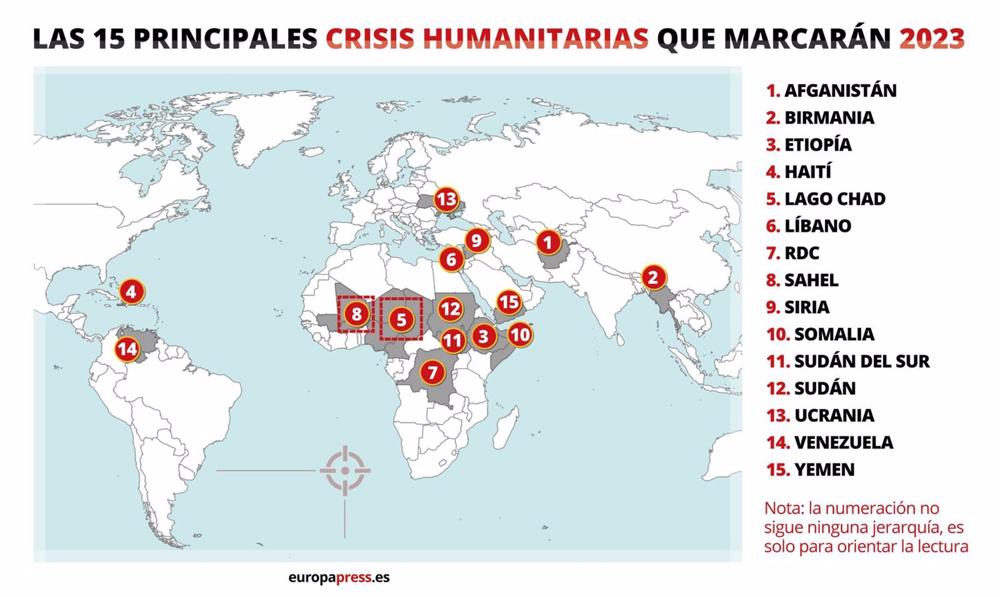
AFGHANISTAN The year begins with the uncertainty of how the Taliban’s decision to ban women from working for humanitarian organizations will affect them, given that they represent a high percentage of workers and are responsible for caring for women and children, who are always among the most vulnerable.
After the Taliban came to power, the number of people in need of aid has increased to 28.3 million – in 2021 there were 18.4 million. Although the level of violence has decreased, although there are frequent attacks by the Islamic State, the severe drought has had a strong impact on the population, which is also facing a severe economic crisis.
BURMA The country is going through an unprecedented political, human rights and humanitarian crisis. The military coup d’état of 2021 has intensified conflicts with some ethnic armed groups, causing an increase in displacements. There are currently 1.4 million displaced persons, one million more than a year ago, and 17.6 million people in need of assistance.
Meanwhile, the Rohingya refugee crisis in neighboring Bangladesh remains unresolved. Nearly one million people from this persecuted minority in Burma are living in appalling conditions in refugee camps in Cox’s Bazar. In recent weeks, arrivals by sea have intensified after dangerous crossings of Rohingyas to the Indonesian coast.
ETHIOPIA The combination of severe drought with the impact of conflict in Tigray (north) and violence in other parts of the country and the resulting displacement has left 28.6 million people in need of assistance.
The peace agreement reached between the Ethiopian Government and the Tigray People’s Liberation Front (TPLF) has brought some relief to the situation in this region, but there are now fears of renewed conflict in the more populous Oromia region. The UN does not expect the situation to improve in 2023 also due to poor rainfall forecasts.
HAITI The Caribbean country is facing a cocktail of political, economic and humanitarian crisis which in recent months has been compounded by insecurity caused by the activity of armed gangs, as well as a new outbreak of cholera. As a result, 5.2 million of the country’s 11.7 million inhabitants require assistance.
The price of the basic food basket has risen 63% in one year and it is estimated that half of the population is hungry, with some 1.8 million in particularly dire circumstances and some areas where famine may be occurring. Should the deployment of international forces requested by the Government take place, OCHA believes that the situation could improve, although it admits that it is difficult to make forecasts in a country where crises are occurring one after the other.
LAKE CHAD A total of 11 million people are in need of assistance in this crisis, the epicenter of which is northeastern Nigeria and which also affects areas of Cameroon, Chad and Niger that are bathed by the lake. The violence, mainly the work of the Islamic State in West Africa (ISWA) and the remnants of Boko Haram, has not abated but seems to be spreading to other areas, especially in Nigeria, previously immune.
According to the UN, there are 5.6 million severely food insecure people, including 300,000 severely malnourished children, and 2.9 million internally displaced persons, 2 million of them in Nigeria, in addition to 624,000 refugees.
LEBANON The unprecedented economic and financial crisis, with a historic depreciation of the Lebanese pound, has led to an increase in humanitarian needs that has resulted in a request for $600 million, 59% more than in 2022. Added to this is the persistent political instability, with the absence of a president since November.
According to the WFP, the basic food basket costs 1,700% more than in October 2019 and the average salary only covers 24% of basic food needs, compared to 93% in 2021. In this context, there are 2.3 million people in need of assistance, including Lebanese and Palestinian and Syrian refugees.
DEMOCRATIC REPUBLIC OF CONGO The UN has made its largest request for funds for the country to date, with $2.3 billion, 20% more than in 2022, demonstrating the increase in needs due to the deterioration of the situation, mainly in the east, where violence by two armed groups – the M23 and the ADF, which acts as an affiliate of the Islamic State – has been exacerbated.
One in four Congolese is food insecure – 26.4 million people – and 6.4 million are acutely malnourished, mainly children under 5 years of age, despite the country’s great agricultural potential. Of the 109 million inhabitants, 60 live in extreme poverty. In addition, there are 5.7 million internally displaced persons, the highest figure in Africa.
SAHEL The situation in the central Sahel has been deteriorating as the jihadist threat has been spreading from northern Mali southward, affecting neighboring Burkina Faso and western Niger and threatening the countries of the Gulf of Guinea.
Currently, 14.4 million people are in need of assistance in these three countries, with Burkina Faso the worst affected, with one in four people in need of help. There are already 2.3 million internally displaced people in the region, 1.7 million of whom are in Burkina Faso, and 4.4 million are food insecure.
Source: (EUROPA PRESS)