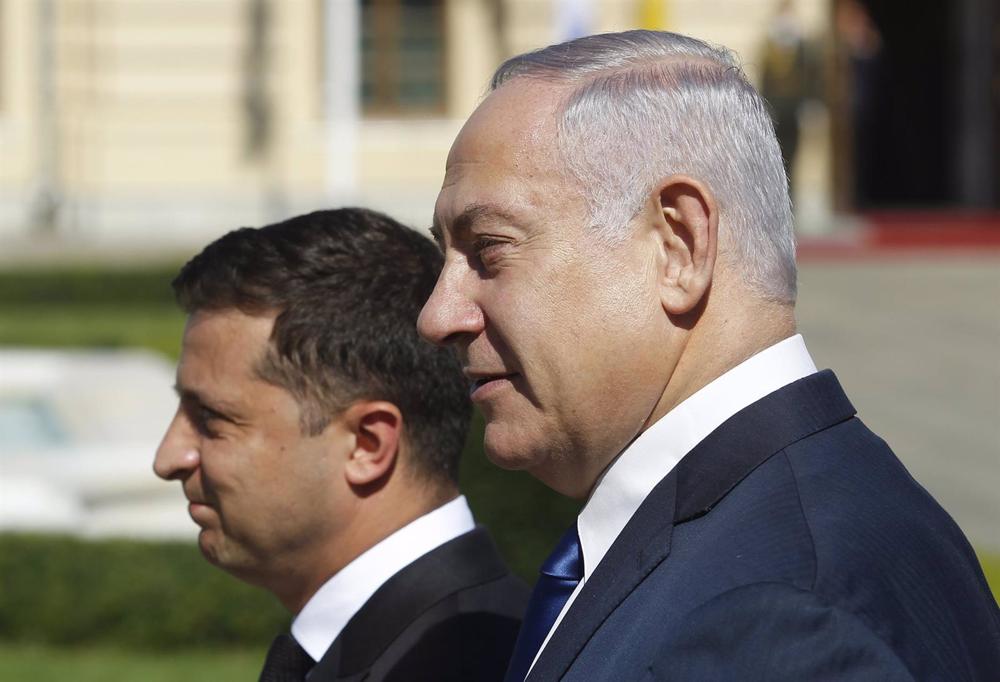
Israel’s Prime Minister Benjamin Netanyahu asked Ukraine’s President Volodimir Zelenski to vote against an International Court of Justice (ICJ) investigation into the legality of Israeli settlements in occupied Palestinian territory; a request Zelenski refused to comply with amid tensions over the lack of Israeli military aid to Ukraine in the war with Russia.
Multiple official Israeli and Ukrainian sources have explained to the US portal Axios that Netanyahu asked Zelenski weeks ago to vote against the initiative before the General Assembly, considering that Kiev had already voted in favor of the decision in a previous round at the committee level.
Zelenski opted instead to order the Ukrainian ambassador to the UN to absent himself from the vote «to give relations with the new Israeli government» led by Netanyahu a chance, according to Ukrainian sources, and after an unsuccessful series of calls in which the Ukrainian president asked his Israeli counterpart to reconsider his position and start delivering military aid to Ukraine.
The Israeli president replied that he would consider the request but did not declare any commitment, hence Zelenski ordered the ambassador to absent himself from the vote; a decision that has caused some unease among the new Israeli government.
«Neither of the two leaders was satisfied and neither got what they wanted,» a senior Ukrainian official explained to the U.S. portal.
The resolution was finally passed with 87 votes in favor, 26 against and 53 abstentions. The relevant document, entitled ‘Israeli practices and settlement activities affecting the rights of the Palestinian people and other Arabs in the occupied territories’, calls on the court to «urgently convey its views» on the «prolonged occupation and annexation of Palestinian territory».
It also urges the opening of an investigation into measures taken by the Israeli authorities to «alter the demographic composition and status of Jerusalem», while accusing Israel of adopting «discriminatory legislation and measures» against the population.
The ICJ, which could take between one and two years to issue its opinion, last ruled on the conflict in 2004, when the General Assembly asked it to intercede. Countries voting against the resolution on Friday now include Israel, the United Kingdom, the United States, Austria, Canada, Germany, Italy and Australia, among others.
Source: (EUROPA PRESS)