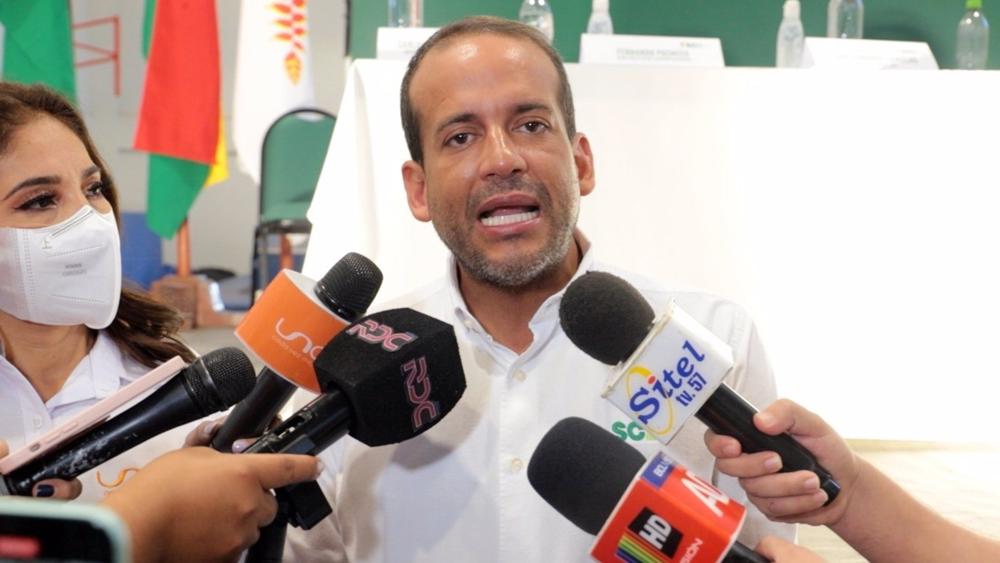
The governor of Santa Cruz, Luis Fernando Camacho, will have to spend four months in pre-trial detention by order of a court following his arrest on charges of inflaming the political crisis that plagued Bolivia in 2019.
The governor was transferred early this morning (local time) to the Chonchocoro prison where he will serve the four-month detention dictated by Judge Sergio Pacheco, reports ‘El Diario’, while the Civic Committee, a powerful civic-business conglomerate, has kicked off the 24-hour «strike» in protest of the arrest.
The Bolivian Minister of Justice, Iván Lima, has assured that Camacho’s detention has been an example of following due legal process, before confirming that he has already rejected one of the two appeals presented by the lawyers of the ex-president of the Santa Cruz Civic Committee.
In this sense, the minister confirmed that Camacho’s defense has presented two appeals for freedom, one in the city of La Paz, already rejected, and another in Santa Cruz, under the same arguments, which is still being considered by the court.
In response to the accusations of kidnapping made by the governor’s lawyer, Martin Camacho, the Minister of Justice assured that the former governor was detained in compliance with a prosecutor’s order after refusing to appear in this case on «repeated» occasions.
The Prosecutor’s Office can activate the arrest of any citizen who refuses to give his statement», he assured before recalling that the process called «Coup d’Etat I», when Evo Morales was forced to resign the Presidency due to pressures from the Armed Forces and suspicions of irregular elections, began two years ago and both Camacho and his defense were aware of the case.
«Neither the arrest warrant, nor the actions of the Police, nor the precautionary hearing can be discussed in the scope of the due process, with legal arguments», added the head of state in a press conference reported by ‘El Deber’, before emphasizing that the application of the norms is the same for all Bolivians, because «there are no first and second class citizens».
Source: (EUROPA PRESS)